
Tennessee secretary of state on redistricting, low turnout
Clip: 8/5/2026 | 7m 14sVideo has Closed Captions
Tennessee secretary of state on redistricting, election security and low voter turnout
Voters head to the polls in Tennessee on Thursday. This year’s primaries come after the Supreme Court cleared the way for the state to redraw its congressional maps. But even as officials are making final preparations, President Trump continues to question election integrity, potentially undermining voter confidence. Amna Nawaz discussed more with Tennessee Secretary of State Tre Hargett.
Problems playing video? | Closed Captioning Feedback
Problems playing video? | Closed Captioning Feedback
Major corporate funding for the PBS News Hour is provided by BDO, BNSF, Consumer Cellular, American Cruise Lines, and Raymond James. Funding for the PBS NewsHour Weekend is provided by...
Tennessee secretary of state on redistricting, low turnout
Clip: 8/5/2026 | 7m 14sVideo has Closed Captions
Voters head to the polls in Tennessee on Thursday. This year’s primaries come after the Supreme Court cleared the way for the state to redraw its congressional maps. But even as officials are making final preparations, President Trump continues to question election integrity, potentially undermining voter confidence. Amna Nawaz discussed more with Tennessee Secretary of State Tre Hargett.
Problems playing video? | Closed Captioning Feedback
Where to Watch PBS News Hour
PBS News Hour is available to stream on pbs.org and the PBS app.
Providing Support for PBS.org
Learn Moreabout PBS online sponsorshipAMNA NAWAZ: Hundreds of thousands of voters head to the polls in Tennessee tomorrow, the only state in the nation to hold Thursday primary elections.
This year's come after the Supreme Court cleared the way for Tennessee to redraw its congressional maps, which will be used for the first time statewide.
But even as election officials are making final preparations, President Trump continues to question election integrity across the country, potentially undermining voter confidence.
Joining us now is Tennessee's Secretary of State Tre Hargett, who's overseen the state's elections since 2009.
Secretary, welcome to the show.
Thanks for being with us.
TRE HARGETT, Tennessee Secretary of State: Well, thank you.
Thank you for the opportunity to visit with you.
AMNA NAWAZ: So you have got big primary elections tomorrow for governor, one U.S.
Senate seat, nine congressional districts, most of the state legislature.
And, as we noted, Tennessee quickly redrew those congressional maps after the Supreme Court decision.
So all nine congressional districts were redrawn.
The map eliminated one Democratic district, I understand, and you have only had three months between the redrawing of those maps and these primaries.
So how do you know that voters have all the information they need about the maps and the precincts?
TRE HARGETT: Well, I would say it's probably the most widely covered redistricting in the history of our state.
Everywhere you look, we have been putting out information about where people could find, what district they were living, what they what district they now live in.
You know, we provided maps.
We have - - we have a GoVoteTN app where you can look up your district information.
And if your voting district changed, then you have got a postcard from your local election commission letting you know your new congressional district.
So every voter has been notified if their district is changed.
AMNA NAWAZ: So you're confident voters have the information they need for tomorrow; is that right?
TRE HARGETT: Absolutely.
If you don't have the information you need, it's because you haven't -- you haven't looked.
AMNA NAWAZ: There's another story that's been widely covered I want to ask you about, and that's related to the Department of Justice suing at least 30 states that didn't share complete voter registration lists.
That includes some Republican-led states, we should note.
And your state did turn over your voter information willingly.
Were you behind that decision?
And, if so, can you tell us what the reasoning was for that?
TRE HARGETT: Well, we consulted with our counsel, and they told us that they believed that the DOJ have a right to that information.
And so I wouldn't say we willingly did it.
I wasn't excited about it, but I tend to listen to my lawyers.
When my lawyers say, you need to give it to them, we did.
AMNA NAWAZ: I wonder how you look at that now, though, because, as you and I speak, the Department of Justice is now zero for nineteen in the court cases that have been decided on this so far.
The judges have been calling some of these moves unprecedented and illegal in one case.
In another one, they called the move to get the voter rolls a fishing expedition.
Was it, in your view now, a mistake to hand over all that voter information, when judges are consistently saying the government doesn't have a right to it?
TRE HARGETT: Well, I relied on advice of counsel.
And at the same token, I'm not sitting here Monday-morning quarterbacking what the last Super Bowl looked like either.
I mean, I'm looking forward to how we're going to run elections.
We're number one on election integrity now for five years in a row.
And if every state did it like Tennessee did it, we'd have a much better electoral system.
AMNA NAWAZ: We're talking about very sensitive voter information here, though, right, last four of Social Security numbers, driver's licenses numbers.
Now the judges are saying the government doesn't need to have that.
Are you worried about how that information might be used?
TRE HARGETT: Well, no, I'm not.
I'm not worried about that.
And, frankly, we have worked together with the federal government through the SAVE system to make sure that only U.S.
citizens and Tennessee citizens are on our voter rolls.
And those last four the Social Security number, we used to as part of that.
AMNA NAWAZ: Can I ask you about that citizenship verification?
Because Tennessee is one of the strictest states in the nation when it comes to voter I.D.
You're one of only 10 states in the country that got a perfect 20 out of 20 score from The Heritage Foundation when it comes to voter I.D.
law.
And the studies have shown that noncitizen voting doesn't seem to be a problem in Tennessee.
So why is that a concern for you?
TRE HARGETT: Well, maybe it's not a problem in Tennessee because of how we run elections here, because of the photo I.D.
law that we have, because of our work across state and federal boundaries to make sure that only Tennessee citizens and U.S.
citizens are on our voter rolls.
AMNA NAWAZ: So, when it comes to elections in Tennessee, I'm sure you heard the president in his prime-time speech last month talk about foreign interference and hacking in our election systems.
I'm curious how many times you, as a secretary of state in Tennessee, have heard from officials at CISA, the government agency responsible for securing those elections and protecting against that hacking.
Have you had reach-out from them, guidance from them, them calling you or offering briefings?
TRE HARGETT: Well, that's a lot of questions to unpack right there.
So, certainly we have talked to CISA in the past.
CISA has offered different recommendations at times.
It doesn't mean we take all of those.
Some of them, we may have already been doing to start with.
So you have got a lot of questions right there.
The bottom line is, is that we work very well with our state Department of Homeland Security.
We work well with the United States Department of Homeland Security to make sure that we protect the physical and the cybersecurity of our elections here in Tennessee.
AMNA NAWAZ: Have you had any briefings from CISA specifically related to the concerns the president brought up in his prime-time speech related to this election?
TRE HARGETT: Well, I have not had one recently, no.
AMNA NAWAZ: No.
And are there any plans to have one?
TRE HARGETT: I don't have anything on my calender right now.
AMNA NAWAZ: OK.
Before I let you go, I want to ask about your voter turnout, because, as you well know, Tennessee has one of the lowest voter turnout rates in the nation, both in general and primary elections.
I'm wondering what you think is behind that and how you can encourage more voter participation.
TRE HARGETT: Well, we are like the cooks.
We open the restaurant, we prepare the food.
We can't make people eat it.
And what drives turnout are competitive races, candidates and parties being competitive.
And, frankly, there's just not been a lot of competitive races here in Tennessee in recent years.
But, also, people have to be willing to talk about politics.
And what really drives turnout, in addition to competitive races, is having friends and neighbors who are willing to talk to one another about politics and encourage people to go vote.
Sometimes, people will say it's hard to vote.
And when they tell me that, I'm like, we have got 14 days of early voting.
We have got 12 hours on Election Day, and they will say it's not convenient for them.
But if we tell people that there's a new iPhone coming out, then they will gladly go stand in line for several hours to go get a new iPhone.
So it's about what you prioritize.
AMNA NAWAZ: Mr.
Secretary, we know it's a busy time for you.
You have a big day tomorrow.
We're grateful to you for making the time.
That's the Tennessee secretary of state, Tre Hargett, joining us.
TRE HARGETT: Thank you, ma'am.
 New
NewHow new ovarian cancer findings may help reduce risk
Video has Closed Captions
How new findings on ovarian cancer origins may help reduce risk (6m 45s)
 New
NewNews Wrap: Senate confirms Erica Schwartz as CDC director
Video has Closed Captions
News Wrap: Senate confirms Dr. Erica Schwartz as CDC director (6m 5s)
 New
NewRetired Army colonel explains Patriot missile capabilities
Video has Closed Captions
Retired Army colonel explains why Patriot missiles are so valuable and in short supply (6m 25s)
 New
NewRussian attacks expose weakness in Ukraine's air defense
Video has Closed Captions
Russian missile attacks on Kyiv expose weakness in Ukraine's air defense (3m 33s)
 New
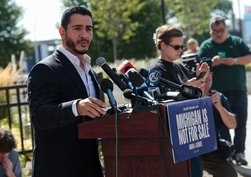
NewWhat El-Sayed's primary win means for Democrats in November
Video has Closed Captions
What El-Sayed's primary win means for Democrats in November (6m 44s)
 New
NewWhat scientists can learn from debris crashing into the moon
Video has Closed Captions
What scientists are learning after SpaceX debris crashed into the moon (5m 7s)
 New
NewWhy the Battle of the Little Bighorn still resonates today
Video has Closed Captions
How the Battle of the Little Bighorn reshaped U.S. policy toward Native Americans (10m 9s)
Providing Support for PBS.org
Learn Moreabout PBS online sponsorship New Episode
- News and Public Affairs

Today's top journalists discuss Washington's current political events and public affairs.

- News and Public Affairs

FRONTLINE is investigative journalism that questions, explains and changes our world.


 New Episode
 New Episode
 New Episode
 New Episode

 New Season
 New Episode
Support for PBS provided by:
Major corporate funding for the PBS News Hour is provided by BDO, BNSF, Consumer Cellular, American Cruise Lines, and Raymond James. Funding for the PBS NewsHour Weekend is provided by...