
Displaced Gazans face dire conditions months after ceasefire
Clip: 12/13/2025 | 6m 5sVideo has Closed Captions
Displaced Palestinians struggle with cold, malnutrition in Gaza months after ceasefire
More than two months after the ceasefire agreement between Israel and Hamas, humanitarian conditions in Gaza remain dire. The United Nations estimates that 1.5 million people lack shelter. Ali Rogin speaks with UNICEF’s Jonathan Crickx about conditions on the ground in southern Gaza.
Problems playing video? | Closed Captioning Feedback
Problems playing video? | Closed Captioning Feedback
Major corporate funding for the PBS News Hour is provided by BDO, BNSF, Consumer Cellular, American Cruise Lines, and Raymond James. Funding for the PBS NewsHour Weekend is provided by...
Displaced Gazans face dire conditions months after ceasefire
Clip: 12/13/2025 | 6m 5sVideo has Closed Captions
More than two months after the ceasefire agreement between Israel and Hamas, humanitarian conditions in Gaza remain dire. The United Nations estimates that 1.5 million people lack shelter. Ali Rogin speaks with UNICEF’s Jonathan Crickx about conditions on the ground in southern Gaza.
Problems playing video? | Closed Captioning Feedback
How to Watch PBS News Hour
PBS News Hour is available to stream on pbs.org and the free PBS App, available on iPhone, Apple TV, Android TV, Android smartphones, Amazon Fire TV, Amazon Fire Tablet, Roku, Samsung Smart TV, and Vizio.
Providing Support for PBS.org
Learn Moreabout PBS online sponsorshipJOHN YANG: In Gaza, Israel says it's killed a top Hamas commander said to be one of the last living architects of the October 7 attacks.
Gaza health authorities said the strike killed four people and wounded at least 25 others.
More than two months after the ceasefire agreement between Israel and Hamas, humanitarian conditions in Gaza remain dire.
The U.N.
estimates that 1.5 million people lack shelter.
Ali Rogin spoke with Jonathan Crickx of UNICEF from southern Gaza.
ALI ROGIN: Jonathan, thank you so much for joining us.
Tell us about what the conditions are like on the ground right now.
JONATHAN CRICKX, UNICEF: The conditions are catastrophic, I must say.
I've been in many, many tents in the past two days and the tents are completely flooded.
I met with tens of children.
They are -- their clothes are wet, the mattresses in the tents are completely soaked.
And those children, they are cold.
They are a huge issue when it comes to hygiene because of course, with those heavy rains, it's bringing a lot of dirty water, sewage water.
You have big pile of rubbish which are being taken away by the rains.
And we are very, very concerned, first of all, to see children getting sick.
And I met many sick children and also children dying from hypothermia.
So it's extremely concerning.
It's really showing the scale of the vulnerability and the needs of these children.
ALI ROGIN: And in terms of the aid situation, the terms of the ceasefire agreement with Israel included a provision that 600 aid trucks enter Gaza every day.
We understand that number is far short of that.
But what is the situation there in terms of aid getting into the area?
JONATHAN CRICKX: The situation is a bit complex.
It's not black or white.
First of all, since the ceasefire, U.N.
agencies like UNICEF have been able to bring more aid inside the Gaza Strip.
That's a fact.
We have been able to distribute a quarter of a million of warm clothes to children.
We have able to distribute 600,000 blankets, 260,000 tarps, 7,000 tents.
So, we are able to do, I would say a lot, but we need 1 million kits of warm clothes for children.
We have 1 million children here in the Gaza Strip, and of course, we have brought one quarter of that.
So the scale of the need, the huge, the immensity of the destruction, when you see that you have nearly 1 million people living in makeshift tents which are made with you know, these kind of tarpaulins, just a plastic sheet on a piece of wood.
So of course this is not made to withstand a storm like the one that we have seen in the past days.
ALI ROGIN: What is UNICEF calling for right now in terms of scaling up that aid?
JONATHAN CRICKX: So we need to have more tents going in.
We need to have more oil supplies.
It's also important that we have all the entry points possible and all the routes possible to bring humanitarian aid inside the Gaza Strip.
We also need things like caterpillars, you know, big machinery, heavy machines to remove big piles of rubbles of also of garbage and these kind, because we have a huge issue when it comes to hygiene and sanitation here.
ALI ROGIN: we are now about two months into this ceasefire.
What would you say in terms of Palestinians quality of life and is it at the level that you thought it might be at this point?
JONATHAN CRICKX: So the markets, you can see way more food on the markets, but many type of food are still very expensive.
So the most vulnerable families are still struggling to get access to it.
We are still treating thousands of children for malnutrition.
You know, the situation is improving.
But yesterday I was one of those interplaced people camp, very much makeshift tents and I met with a little girl, she's three years old, her name is Bisan and she was very, very cute.
But at the same time she was extremely cold and her sweatpants were extremely dirty and wet and she was just like there playing and standing in the mud.
And when you enter her tent, there is literally nothing.
And then you have that tent where water is falling from all of it.
And, you know, this is just heartbreaking.
This little girl, she should just have a proper shelter.
She should be able to go to a kindergarten, play with toys and not be in a situation like she is today.
So the overall situation remains extremely dramatic.
The cease fire is precious.
It's very important because it brought a little respite.
But the living conditions remain extremely challenging for children.
ALI ROGIN: Jonathan Crickx with UNICEF, thank you so much.
JONATHAN CRICKX: Thanks for having me.
JOHN YANG: Still to come on PBS News Weekend, the effect tariffs on China are having on prices for shoppers this holiday season and the world famous couple who've devoted their lives to protecting Africa's wildlife.

How tariffs are making the holidays less merry for shoppers
Video has Closed Captions
Clip: 12/13/2025 | 3m 55s | How tariffs on China are making the holiday season less merry for shoppers (3m 55s)
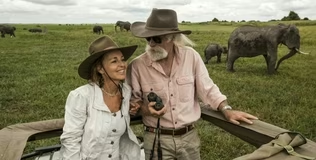
Jouberts reflect on 40 years of African wildlife photography
Video has Closed Captions
Clip: 12/13/2025 | 10m 49s | Beverly and Dereck Joubert reflect on 40 years of African wildlife photography in new book (10m 49s)

News Wrap: Trump vows retaliation for U.S. deaths in Syria
Video has Closed Captions
Clip: 12/13/2025 | 3m 1s | News Wrap: Trump vows retaliation for killing of Americans in Syria (3m 1s)
Providing Support for PBS.org
Learn Moreabout PBS online sponsorship
- News and Public Affairs

FRONTLINE is investigative journalism that questions, explains and changes our world.

- News and Public Affairs

Amanpour and Company features conversations with leaders and decision makers.












Support for PBS provided by:
Major corporate funding for the PBS News Hour is provided by BDO, BNSF, Consumer Cellular, American Cruise Lines, and Raymond James. Funding for the PBS NewsHour Weekend is provided by...