
July 27, 2026 - PBS News Hour full episode
7/27/2026 | 57m 46sVideo has Closed Captions
July 27, 2026 - PBS News Hour full episode
July 27, 2026 - PBS News Hour full episode
Problems playing video? | Closed Captioning Feedback
Problems playing video? | Closed Captioning Feedback
Major corporate funding for the PBS News Hour is provided by BDO, BNSF, Consumer Cellular, American Cruise Lines, and Raymond James. Funding for the PBS NewsHour Weekend is provided by...
July 27, 2026 - PBS News Hour full episode
7/27/2026 | 57m 46sVideo has Closed Captions
July 27, 2026 - PBS News Hour full episode
Problems playing video? | Closed Captioning Feedback
Where to Watch PBS News Hour
PBS News Hour is available to stream on pbs.org and the PBS app.
Providing Support for PBS.org
Learn Moreabout PBS online sponsorshipGEOFF BENNETT: Good evening.
I'm Geoff Bennett.
Amna Nawaz is away.
On the "NewsHour" tonight: Seattle police search for another suspect after a deadly shooting at a crowded festival beneath the Space Needle.
The weekend passes with no new U.S.
attacks on Iran.
That's as experts worry about America's shrinking weapon supply.
And massive youth-led protests lead to the resignation of India's education minister, exposing cracks in that nation's government.
UMANG GUPTA, Former Modi Supporter (through translator): He fears losing power.
They know, if this protest goes on for a long time, the government can fall.
(BREAK) GEOFF BENNETT: Welcome to the "News Hour."
Seattle police are hunting for a suspect tonight after gunfire erupted at a food festival yesterday, killing at least three people and wounding at least four others.
One suspect is already in custody.
A third shooter is believed to have died at the scene.
Tonight, the city is grieving and on edge.
The scene of another mass shooting in America, this time in the shadow of Seattle's iconic Space Needle.
MAN: Oh, my God.
GEOFF BENNETT: On Sunday, just after 6:00 p.m.
local time, gunfire rang out at the popular Bite of Seattle food festival, a gathering that draws hundreds of thousands of people each year, including many families.
ROBERTO RAMIREZ, Festival Vendor: We suddenly heard some firecrackers, what I thought were firecrackers, and people started yelling "Shooter, shooter," and there was like an a stampede of people just running.
MAN: Get down, get down, get down.
GEOFF BENNETT: Food vendors in their tents forced to duck and hide as crowds hurried to safety.
A massive police presence descended on the scene at Seattle Center backed by armored SWAT vehicles.
TALIJAH SATACK, Visitor: People was falling over strollers.
People was hiding.
It was like everybody was fearing for their life.
ESTAN WAKONABO, Photographer: I don't know what's the situation, but I ran over there as fast as can with my camera, and that's when I saw people on the ground.
GEOFF BENNETT: First responders tended to multiple victims caught in the crossfire, as investigators believe the suspects were shooting at each other.
In addition to the dead, four others were wounded, including a 2-year-old.
They were taken to a nearby hospital, and all have since been released, except the toddler, who is listed in satisfactory condition.
One suspect, a 15-year-old, surrendered at the scene, but the search is on for another who officials say may have fled.
Court documents reviewed by the Associated Press say a third died in the gunfight.
Officers combed the site, searching for evidence, finding two guns.
Despite the ongoing search, law enforcement and local officials stressed, there is no ongoing danger to the public.
SHON BARNES, Seattle, Washington, Police Chief: Our officers, as well as members from the fire department medic team ran toward gunfire in an attempt to render lifesaving aid and to disarm someone who was actively firing a weapon into a crowd.
GEOFF BENNETT: But, last night, the city's mayor said the shooting reflects a deeper problem.
KATIE WILSON (D), Mayor of Seattle, Washington: We have far too much gun violence in this city and in this country.
And we're coming off of a week in Seattle where we have had three major incidents of gun violence in just a few days.
We have a lot of work to do as a city and as a country to make this better.
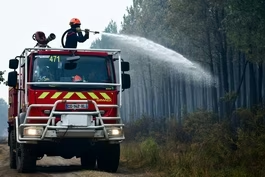
GEOFF BENNETT: Shifting our focus overseas now, today, firefighters in Southwest France are battling a wildfire that's burned an area four times the size of Paris and forced more than 200,000 people to flee.
The country's interior minister said today the fire that's burning near the city of Bordeaux is no longer growing but remains dangerous.
More than 100 homes in the small coastal town were burned.
Meantime, Spain continues to battle its worst wildfire in recent history, including one that's burned an area five times the size of Barcelona.
Spain's prime minister says climate emergency has created the conditions for the fires.
PEDRO SANCHEZ, Spanish Prime Minister (through translator): What we are living is not a succession of isolated events.
This is no longer an exception.
It is the new reality.
Summers are becoming increasingly difficult, destructive, and therefore deadly.
GEOFF BENNETT: Around a dozen countries have sent planes, helicopters and other help to Spain and France so far.
Firefighters in both countries are racing to combat the blaze ahead of a heat wave that's expected in the region later this week.
Meantime, nearly 100 million Americans are under active heat alerts as climbing temperatures and severe humidity grip much of the country for a third straight day.
Extreme heat warnings were in effect today from California and Arizona in the West to Illinois and Kansas in the Midwest and Mississippi in the South.
The heat index in parts of the North and Southwestern U.S.
is expected to exceed 105 degrees.
The extreme conditions are the results of the latest heat dome that traps hot air, causing more extreme temperatures.
And, in Wisconsin, a tornado caused extensive damage today, leaving thousands there without power.
MAN: This is the Main Street in Menasha.
GEOFF BENNETT: Video shows the wreckage left behind, with damaged homes and cars flipped over.
The National Weather Service confirmed the tornado hit Winnebago County, about 90 miles northwest of Milwaukee, and described it as extremely dangerous.
Weather officials are warning that damaging winds and hail could continue as storms move across the region.
Traffic began flowing over a new international bridge connecting the U.S.
and Canada today, even as trade tensions between the two trading partners remain high.
Footage of the first truck crossing the mile-and-a-half-long span was posted to social media.
The Gordie Howe Bridge was named after the Canadian hockey icon and is meant to serve as a vital route for trade and tourism.
Last week, President Trump announced a plan to place 50 percent tariffs on a range of Canadian goods.
Today, he was just south of the Canadian border in Michigan, making his economic case.
DONALD TRUMP, President of the United States: Michigan finally has a president who stands up for Michigan autoworkers.
GEOFF BENNETT: Mr.
Trump told a crowd at a GM facility that his policies are good for their business, Michigan's economy, and especially the auto industry relies heavily on Canada.
In Germany, Chancellor Friedrich Merz is calling for tougher security laws after it emerged that the suspect from this weekend's Berlin Pride attack had tried to join ISIS.
Flowers and candles marked the scene where one woman was killed and more than two dozen others were injured on Saturday, when the suspect allegedly drove a van into a crowd and then started attacking people with a machete.
The 21-year-old German citizen was shot and killed on Sunday following a 24-hour search.
He had previously been sentenced to prison and had only been released two months ago.
The mayor has called his actions an attack on our free society.
Georgia's Okefenokee Swamp is the newest U.S.
location added to the list of UNESCO protected World Heritage Sites.
Okefenokee is the largest blackwater swamp in North America and the largest freshwater ecosystem, making it an ideal sanctuary for wildlife.
Also added to the list: NARRATOR: On beaches called Utah and Omaha and Sword and Gold and Juno, they come ashore.
GEOFF BENNETT: The famous D-Day landing beaches in Northern France, they were recognized for their central role in liberating Western Europe from Nazi occupation.
And Mount Olympus in Greece was also selected.
It's the country's highest peak and the mythical home of the 12 Olympian gods.
In business news, the CEO of Cracker Barrel is stepping down nearly a year after a rebranding effort sparked a nationwide backlash.
Julie Masino was behind the move to replace the chain's longtime logo featuring an old man in overalls with a more streamlined image.
Fans of the restaurant chain were outraged.
Even President Trump weighed in.
The company quickly reversed course and returned to its original logo.
Shares of Cracker Barrel fell more than 2 percent today.
Across the rest of Wall Street, stocks ended mixed.
The Dow Jones industrial average gained around 260 points.
The Nasdaq fell around 40 points.
The S&P 500 ended roughly flat to start the week.
Still to come on the "News Hour": the ongoing cyclosporiasis outbreak and rising number of measles cases raise questions about public health; Tam rake and Amy Walter break down the latest political headlines; and a new documentary explores why mothers in the U.S.
lack the support systems found in other countries.
The high-intensity exchange of fire between the U.S.
and Iran paused over the weekend.
And, today, President Trump played up the prospects for negotiations.
Our Nick Schifrin reports now on the state of the war.
NICK SCHIFRIN: Today, on the waters where one-fifth of the world's oil and natural gas used to flow, ships are stuck, and there is an eerie quiet.
It's a very different sound than the last two weeks of nightly U.S.
fire and Iranian missiles and drones launched at the U.S.'
Gulf allies.
Today, President Trump said the recent sound of silence was giving diplomacy a chance.
DONALD TRUMP, President of the United States: We're having good talks.
So we will see what happens.
I think there's a good chance that something could happen.
And if it does, good.
If it doesn't, we go back to doing what we were doing two days ago.
NICK SCHIFRIN: Although Iranian spokesperson Esmaeil Baghaei said there were no direct talks.
ESMAEIL BAGHAEI, Iranian Foreign Ministry Spokesman (through translator): Mediators may convey messages from the American side to us regarding the current developments in the region, but at present we have no negotiations with the American side.
NICK SCHIFRIN: But the U.S.
pause isn't only about diplomacy.
It's also about the inventory of American air defense and Arab warnings.
Two U.S.
officials tell me that, late last week, the military presented the president with multiple options.
The military argued, if the president decided to escalate, that would erode Iran's capability to attack ships and U.S.
bases and would therefore save precious American air defense interceptors.
But the U.S.'
Gulf allies were warning the president against escalation, fearing Iranian attacks on Arab capitals, desalinization plants, and commercial centers that the U.S.
could not prevent.
The military also told the president that if instead the strikes are continued at the same level as they had been over the past two weeks, Iran would continue its missile and drone attacks and that could challenge the U.S.
ability to defend its own bases from Iranian attacks.
In the end, the president opted to pause entirely.
And, today, the president denied the pause was because of weapons shortages.
DONALD TRUMP: We're in very good shape.
But for some of the more sophisticated stuff, we'd certainly like to have more.
NICK SCHIFRIN: But war has its own momentum, and this one is threatening to escalate.
Today, the Iran-backed Houthis released video of what they said was a shot-down Saudi drone.
This weekend, Houthis struck two major Saudi oil facilities on opposite coasts separated from each other by 900 miles.
Earlier this month, the Saudis bombed a Houthi-controlled airport.
The violence threatens to end the Saudi-Houthi shaky 4-year-old cease-fire.
Today, the Houthis threatened that the war would widen.
BRIG.
GEN.
YAHYA SAREE, Houthi Military Spokesman (through translator): We will not hesitate to expand our military movements and escalate our actions in the coming hours and days, in line with our policy of blockade for blockade and escalation for escalation.
NICK SCHIFRIN: Saudi Arabia is leading the military response to the Houthis with U.S.
encouragement.
But, today, President Trump expressed a willingness to help.
DONALD TRUMP: But we're not involved with that, but we may.
If they're a problem, we will probably have to get involved.
NICK SCHIFRIN: But the U.S.
military is still involved in an ongoing Iranian port blockade.
The military said it boarded two ships and redirected a dozen after they did not comply despite -- quote -- "repeated warnings."
In a statement sent to the "News Hour," Steven Cheung, White House communications director, said -- quote -- "The United States military has enough weapons and munitions to serve all of the commander in chief's strategic goals.
It would be wise for Iran to work toward a negotiated deal.
Otherwise, they know what will happen."
We look now at one challenge the U.S.
confronts in the war with Iran, as well as in other conflicts over the last few years, a shortfall in air defense.
For that, we turn to Jerry McGinn, a former senior official in the Defense Department's Office of Manufacturing and Industrial-Based Policy who's also worked for defense contractors.
He's now a senior fellow at the Center for Strategic and International Studies.
Jerry, welcome.
Thanks very much for being here.
JERRY MCGINN, Center for Strategic and International Studies: Great to be with you, Nick.
NICK SCHIFRIN: As we just heard, President Trump today denied that shortages had anything to do with the pause.
But he did acknowledge the U.S.
wanted more -- quote -- "sophisticated weapons."
That's presumably a reference to things like the Patriot air defense.
The U.S.
has used Patriots for years in many places.
But is there a shortage today?
And why?
JERRY MCGINN: Well, we have done analysis on Operation Epic Fury in Iran and other recent areas.
And there has been -- we have used a lot of munitions, as you have seen over the past several months, particularly interceptors like Patriot and theater air missile defense.
But we have enough for the current contingency.
The question is, the risk is in if we were -- if a situation were to happen elsewhere in the world.
NICK SCHIFRIN: Meaning we have enough for the Iran war, according to your analysis, but if something were to happen in Taiwan or elsewhere, that's where the U.S.
would actually be short.
JERRY MCGINN: Exactly.
Exactly.
NICK SCHIFRIN: Why can't Patriots, why can't air defense systems be made like trucks, where they come off the assembly line in high batches quickly?
JERRY MCGINN: Yes, that's a great question.
Well, you see, the Patriot and the munitions we use today were principally designed for performance, for having dramatic effects on the targets.
And they are tremendous.
They are exquisite weapons.
However, they were not built and designed to be built like Ford trucks.
They are essentially handmade in a lot of ways.
And it takes 24 months to create a - - from contract award to delivery to create a Patriot missile.
Likewise, Tomahawks take about three years.
So you can't stamp them -- crank them out in a really quick manner.
NICK SCHIFRIN: So perhaps this is a stupid question, but is there a way to make them like Ford trucks, rather than, I don't know, Faberge eggs?
JERRY MCGINN: Yes.
No, well, that's what they're the department is trying to do.
They have launched efforts to build lower-cost interceptors that can be built quickly, as well as munitions, a whole new class of munitions, which we will talk about hopefully.
NICK SCHIFRIN: Whole new class of munitions, but it's still the challenge that the department faces, that the U.S.
military faces... NICK SCHIFRIN: ... that simply it is not possible to build more quickly for the challenges that we face today, right?
JERRY MCGINN: Well, it is, but you have to start building more Patriots in different places, in other facilities or in other countries.
So you can get there.
It's just going to take a while to ramp up.
And, likewise, what the department is doing is building what I call the breadth of munitions, building lower-cost options that can deliver sooner, or as opposed to some of these more exquisite munitions.
NICK SCHIFRIN: So talk about that.
I mean, we have heard efforts from the Biden administration.
We have heard efforts from the Trump administration.
We have heard announcements by companies like Lockheed, the PAC-3 ACE, a kind of cheaper version of the Faberge egg-style Patriot air defense missile.
JERRY MCGINN: Right.
NICK SCHIFRIN: I mean, how much improvement has there been over the last few years between the Pentagon and industry to try and make more faster?
JERRY MCGINN: Well, I think there has been a lot of effort.
What's different since the Trump administration has arrived is the real scale, that they really have put a lot of effort and a lot of money into -- in production, through the agreements to build more Patriots and these exquisite munitions to building what the Air Force calls the family of affordable mass munitions.
These are simpler designed munitions that are much less expensive, but have about 85, 90 percent of the capabilities.
And these are going to be delivered in fiscal year '27 or '28, according to the president's budget requests.
NICK SCHIFRIN: And when I talk to industry, they always complain that the budgets aren't long enough, guaranteed for long enough, right?
JERRY MCGINN: Yes.
NICK SCHIFRIN: I mean, you have heard this for years.
Is that a legitimate complaint that the Pentagon can't guarantee a steady order stream from industry, or is industry being greedy?
JERRY MCGINN: No, I think both things are correct.
I mean, the demand signal -- for ultimate demand signal for a company is a contract.
But the Pentagon can only obligate the money that it has.
Congress has to appropriate money.
So, like, these longer-term deals that the Pentagon is signing with companies are seven years, but they can't -- they're not guaranteed.
They're not contracts.
They are best effort agreements.
And so they are about as good as the government can give of the demand signal for the companies.
And, in return, the companies are making investments.
And they're doing things like -- RTX announced last week almost 700 million in capital expenditures for this quarter alone, a 26 percent increase year over year.
NICK SCHIFRIN: And, quickly, how would it improve things if Congress were able to actually pass budgets and so we had less fluctuation and longer-term expectations that we could actually predict?
JERRY MCGINN: Yes, there's a couple things.
Well, one Congress can grant multiyear appropriations, which they have done on a number of munitions, that allows for longer two-year contracts that allows money to be spread over period of time, which again helps with that demand signal.
And then passing budgets on time is very critical.
And that's been a challenge, as you know.
NICK SCHIFRIN: Yes, it has for many years.
Jerry McGinn, thank you very much.
JERRY MCGINN: Great.
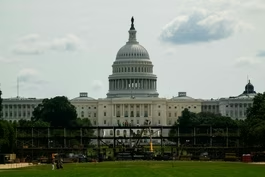
GEOFF BENNETT: On Capitol Hill, it is a split screen.
The House is out for summer recess, but the Senate is very much in session, working through a packed and complicated agenda that includes a first vote tonight on President Trump's pick as the national director -- the director of national intelligence.
Our Lisa Desjardins is here with more.
So, Lisa, let's start with the action tonight, this key vote on President Trump's pick for DNI.
Tell us more about it.
LISA DESJARDINS: Right.
This vote for the director of national intelligence is about the position created after 9/11 to coordinate intelligence.
So it is a very big deal.
The past four months, this agency has been run by an acting and controversial selection who really has focused on just shrinking the agency.
Let's talk about the permanent nominee.
That is Jay Clayton.
He right now is the U.S.
attorney for Manhattan.
And if you look at the Senate floor right now, you can see the vote under way.
This is seen as an experienced nominee, and he has just gotten enough votes to advance.
We expect his final confirmation tomorrow.
But, until then, Geoff, Bill Pulte remains the acting DNI.
He is controversial for a few reasons, but one is he's continuing to make major decisions even now.
Last night, he posted on X - - quote -- "As of this evening, we just finished a fourth round of thoughtful, measured layoffs."
The agency didn't respond to my request for exact numbers, but sources familiar tell me that Pulte has laid off some 200 or more people just in the few weeks that he's been acting director.
If Jay Clayton is confirmed tomorrow, this will be Pulte's last full day on the job.
GEOFF BENNETT: Another thing we're watching, Lisa, is President Trump publicly criticizing the Senate Republican leader, John Thune.
That isn't entirely new, but the fact that Thune is pushing back, that is unusual.
LISA DESJARDINS: Right.
This whole situation is a bit rare, except for the Trump factor, when you have these public airings that are unusual.
Now, this tension is in part because Thune is a defender of the Senate, but he also can count, Geoff.
He knows there are not 60 votes for much of the Trump agenda.
So let's dial back to what we have seen back and forth.
Trump had some important jockeying this morning.
He wrote on TRUTH Social: "I can't believe how lucky the Democrats got with this Senate leadership."
That's a jab.
But Thune has responded consistently to me and to others.
He has said, if President Trump wants the votes, he needs to work the phones and try and get the votes.
Which sounds normal, but that's unusual to say something about President Trump that way.
It's interesting.
Late today, Trump had a different tune on Air Force One when he was asked about his relationship with Thune.
DONALD TRUMP, President of the United States: It's fine.
It's fine.
He's got to get his job done.
It's fine.
I have a good relationship with John Thune.
He's just got to get his job done.
LISA DESJARDINS: Good relationship.
Got to get his job done.
The truth is that Trump knows he can't get the 60 votes himself.
And why?
Because he himself is responsible for some of those senators' careers ending because he attacked them.
GEOFF BENNETT: So what's at stake here?
What are Republicans trying to do exactly?
LISA DESJARDINS: I'm excited to talk about this.
It can look like a big blurry picture.
The Senate has a stacked agenda, not much time.
The Senate's here just this week and next.
But let's take a look at what's on the to-do list and try and simplify things.
First, these are some six items that are on Republicans' to-do list, fund government by October, fund the Iran war at some level, reauthorize spy powers under the Foreign Intelligence Surveillance Act, FISA, pass the key defense bill the NDAA, a farm bill, the elections bill the SAVE Act.
That's a lot.
Let's organize things, shall we?
Let's put them in three columns so I can help people understand where things stand.
There on the left you see what's really possible when I talk to Republicans.
They think they can get a bipartisan funding deal.
They think somehow they can figure out an Iran war funding formula.
But those middle three, they are in limbo.
That's FISA, the defense bill, and the farm bill, probably until after the election.
What's least likely is the SAVE Act.
And what's amazing, Geoff, that's the thing President Trump says has to pass or he won't support anything else.
GEOFF BENNETT: Right.
LISA DESJARDINS: So Trump is really the threat to a lot of the Republican agenda.
The question is, how far will he go?
GEOFF BENNETT: And Senate Republicans have another issue, and this is the prolonged absence of Kentucky Senator Mitch McConnell.
There was an update today on his health?
LISA DESJARDINS: That's right.
There was.
First of all, he is needed for the farm bill to move forward out of committee.
This is the update.
We got a new photo from his team.
It shows him again, they say, in rehab.
The statement from McConnell said he's intensely working through rehab, trying to work when he can.
Interestingly enough, the Capitol's attending physician also sent a statement, saying again the rehab is due to his fall and McConnell's related childhood polio.
But something I hadn't seen before from the attending physician of the Capitol, they noted that McConnell has doctors from the Capitol visiting him every day.
There's no word on when he will return.
GEOFF BENNETT: Lisa Desjardins, thanks, as always.
LISA DESJARDINS: You're welcome.
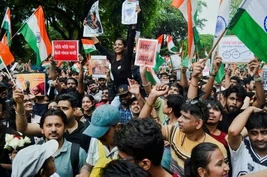
GEOFF BENNETT: They call themselves the Cockroaches after a top official compared India's jobless youth to the pests.
Now, days after their protests toppled the education minister, students say police are coming for them.
What started as outrage over leaked medical entrance exams has turned into one of India's largest youth-led protest movements, challenging India's prime minister.
"News Hour" producer Zeba Warsi reports now on how India's Gen Z took on one of the world's most powerful leaders and what it means for the country's future.
ZEBA WARSI: The world's largest youth population just made their powerful government buckle under pressure.
Beneath the celebration was something remarkable, India's youth discovering the power of their own voice.
WOMAN (through translator): The government has messed with the wrong Gen Z people.
You can break bodies, but not baddies.
ABHIJEET DIPKE, Cockroach Party Founder: It's a victory for the Constitution of India.
It's a victory for the people of India.
And it's a defeat for the dictator.
ZEBA WARSI: That's Abhijeet Dipke, a graduate student at Boston University who sparked a movement from an insult after India's chief justice compared unemployed young people to cockroaches.
Dipke launched the satirical Cockroach Janta Party, or CJP, a play on Prime Minister Narendra Modi's ruling BJP.
Today, its Instagram page has grown to over 25 million followers, more than twice that of the BJP.
It all began with a leak of a national medical school entrance exam taken by two million aspiring medical students across the country.
It's an exam they can prepare to take for years with private tutors and offers a way out of poverty for those who do well.
The decision to invalidate the test results was unbearable for many students, like Pradeep Kumar (ph).
His mother, Sushila Devi, says her son was so distressed that he took his own life.
SUSHILA DEVI, Mother of Student Who Died By Suicide (through translator): He felt that if the exam was held again, then he may or may not be able to do so well.
There was already so much death burden on his father, he just decided to die.
ZEBA WARSI: More than 20 other young students made the same tragic decision.
Their unfulfilled dreams have become a generation's grief.
That turned to anger.
Tens of thousands of students took to the streets, calling themselves Cockroaches, demanding the dismissal of the education minister.
Last week, they marched toward the Parliament.
The government responded with a violent crackdown, beating unarmed students with batons, using tear gas and even pellet guns.
Students, journalists, and witnesses gathered video to document and verify the attacks on a digital platform that became known as The Protest Record.
International human rights organizations have called out the Indian government for using excessive force.
And if the government's goal was to empty the streets, it had the opposite effect.
The protest started in New Delhi and quickly spread across the country.
Indian politicians who opposed Prime Minister Modi, including opposition leader Rahul Gandhi, backed the students, demanding accountability for what they called a brutal clampdown.
For weeks, the revolution was not televised, as most mainstream media in India support the government.
But news spread on social media, with tens of thousands of Instagram Reels watched by millions.
Students can be seen mocking the police force that beat them.
And the posts turned protesters into Instagram celebrities.
Analysts say India has witnessed widespread protests before, but this moment feels different.
(CHANTING) ZEBA WARSI: India's Gen Z are blaming him for the police violence and criticizing his divisive politics.
NARENDRA MODI, Indian Prime Minister: Thank you, friends.
ZEBA WARSI: It took seven weeks of protests, but Modi finally relented and promised to get to the bottom of the medical exam leaks.
This weekend, the education minister resigned.
UMANG GUPTA, Former Modi Supporter (through translator): He fears losing power.
They know, if this protest goes on for a long time, the government can fall.
ZEBA WARSI: Raised in a family of devoted Modi supporters, 22-year-old Umang Gupta once led her university's chapter of Modi's BJP Party.
But its crackdown on the Cockroach protesters changed everything for her.
UMANG GUPTA (through translator): I have joined the protest against my parents' wishes.
So many kids have stood up to their parents and they are getting beaten up.
They are being called terrorists.
ZEBA WARSI: She said India's youth is now determined to take action against what they see as democratic backsliding.
UMANG GUPTA (through translator): When there is a fire within, we can stay hungry too.
When there is courage within, we are unstoppable.
That is the power of every youth.
The youth is the future.
ZEBA WARSI: The Cockroach Movement may be over for now, but, today, its leaders said dozens of students are still being targeted by police across the country, particularly from minority groups.
Students say protests will resume unless those cases are dropped.
NEHA BORA, National President, All India Student Association: Nobody believes that this victory is because of the benevolence of the government.
People are very, very, very frustrated even now.
ZEBA WARSI: Student leader Neha Bora spent 23 days on a hunger strike and emerged as one of the movement's leading voices.
NEHA BORA: This anger, this deep, bone-deep frustration with the way teens were, all of that being handled with brute force, they're just tired of the same old script.
ZEBA WARSI: Bora said Prime Minister Modi may have figured a way to slip out of this crisis, but the students will continue to hold him to account.
NEHA BORA: It's a good thing that he accepted one demand of ours, because the next demand is his resignation.
ZEBA WARSI: India's youth have made themselves impossible to ignore.
And they have shown that even the most powerful governments can be forced to bend to the will of the people.
For the "PBS News Hour," I'm Zeba Warsi.
GEOFF BENNETT: Public health concerns are growing, as cyclosporiasis cases surge, and now a salmonella outbreak across 17 states has many Americans raising concerns about U.S.
food safety.
William Brangham tells us more.
WILLIAM BRANGHAM: Geoff, these back-to-back cases where people are getting sick from food have put many people on edge and raised questions about the nation's food supply.
With nearly 4,200 confirmed cyclospora cases nationwide across nine states, and more than 7,400 additional unconfirmed cases, plus a salmonella outbreak linked to eggs that has sickened almost 100 people so far, consumers are wondering if enough is being done to keep unsafe food out of our stores.
For more on these concerns, we are joined again by Caitlin Rivers.
She's an epidemiologist at Johns Hopkins University.
Caitlin, so nice to have you back on the program.
Let's start off with this troubling pattern.
We have got this very, very big cyclospora outbreak happening, really concentrated in Michigan, but we're also seeing the salmonella outbreak.
Is this just a particularly bad year or is something else going on here?
DR.
CAITLIN RIVERS, Epidemiologist, Johns Hopkins Center for Health Security: I think both are true here.
There is no question that this is a very large outbreak of cyclosporiasis.
To my knowledge, it's the largest on record.
And so that is absolutely consequential.
The addition of the salmonella outbreak in eggs is unsettling, but actually not uncommon.
There are one to two large outbreaks of something, some sort of foodborne illness each month.
And so currently it's salmonella and shelled eggs, but the existence of a second sizable outbreak is not in itself notable.
WILLIAM BRANGHAM: Is there a connection between these two?
I mean, I know cyclospora, we have seen that linked to contaminated water being sprayed onto lettuce and in some cases berries, but we're still searching for the root cause of that, or the root causes, salmonella, as you mentioned, linked to eggs.
Is there any linkage between these two things, or are they just separate outbreaks?
DR.
CAITLIN RIVERS: They're just separate outbreaks.
They're caused by different pathogens, different food items.
Different states are affected.
What they have in common is that our food system is very interconnected.
There are very large food producers that distribute to many, many states, reach often millions of consumers.
And so when we see outbreaks like this, it's because we largely share a food supply with our neighbors.
WILLIAM BRANGHAM: There have also been a series of cuts made by the Trump administration to some specific surveillance monitoring programs, as well as much, much broader cuts that have trickled down to the public health world writ large.
Is it fair to say that those cuts are somewhat complicit in this or not?
DR.
CAITLIN RIVERS: It's hard to draw a straight line because we don't necessarily see the inner workings of the people who used to work there, but are now RIFed, or, that is to say, laid off, or the direct cut line to budget cuts.
But I can say with confidence that, when you lose a quarter or a third of your public health work force, when you are under strain for coming up on six-plus years coming out of the pandemic, the consequences of that do matter.
They do manifest.
And we like to say in public health that, when we do our jobs right, nothing happens, and we're seeing now the opposite of that, where things are happening.
And I think we need to recognize that there are -- there are things we can do, which is to say, investments and support, that can help to reverse that trend.
WILLIAM BRANGHAM: Cyclospora in particular is hammering Michigan.
Do you have any sense as to why it is so bad in that state?
DR.
CAITLIN RIVERS: I think there are two probable reasons.
One is that they received the contaminated product, right?
They had the shredded lettuce, the iceberg lettuce from Taylor Farms.
But I also think Michigan has done a very good job alerting the public to the existence of this outbreak and educating providers on the need to identify and test cases.
And so although you may see higher numbers and think, oh, dear, that's worse, in some ways, it's better because it means that public health officials have more information to be able to identify the source and take the necessary actions to keep people safe.
WILLIAM BRANGHAM: Alongside those two outbreaks, we have also seen another virus reemerge, and that is measles.
And we have got this record number of cases this year.
I believe it's 2,300, which is, I think, the worst in 35 years, I believe it is.
This was a virus that we had once basically eradicated in the U.S.
Why are we seeing a return of that virus?
DR.
CAITLIN RIVERS: It's true.
This is already a record year for measles.
We have surpassed last year's total already in July, and this is the biggest year since the virus was declared eliminated in 2001.
We have a safe and very effective vaccine against measles.
And so the reason that we're seeing these increased cases is because that vaccine coverage is falling.
The good news here is that the trend is reversible.
If we are able to increase vaccine coverage, then we will be able to return to a state where we can say measles no longer circulates.
But, unfortunately, today that's not the case.
WILLIAM BRANGHAM: And some of what you're talking about is, I think, driven by some messaging that we have been hearing coming out of HHS and the health secretary, Mr.
Kennedy.
Do you think, though, that state and local public health departments are able to step in when you're talking about salmonella and cyclosporiasis system and measles and the messaging involved in that?
Are they up to that task?
DR.
CAITLIN RIVERS: Oh, absolutely.
State and local public health officials are actually the front lines.
Many people don't know that public health in the United States is federated, which means it's the state and local officials who have the power and the ability to act, whereas federal officials, at least on the CDC side, it's different for FDA, but they act in a more advisory, technical capacity.
And so I have absolute confidence in our ability, our state and local officials' ability to combat these threats, but they do need resourcing and support.
They can't do it in the absence of money and people.
And so that really comes back to the need to continue to invest in public health and give our systems what they need to thrive.
WILLIAM BRANGHAM: Caitlin Rivers of Johns Hopkins University, always great to hear from you.
Thank you so much.
DR.
CAITLIN RIVERS: Thank you.
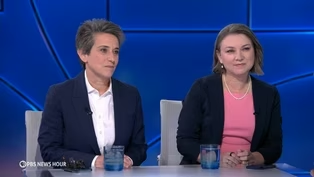
GEOFF BENNETT: With fewer than 100 days to go until the midterms, both parties are gearing up for a combative and expensive battle for control of Congress.
With more on what comes next, we're joined now by our Politics Monday duo, Amy Walter of The Cook Political Report With Amy Walter and Tamara Keith of NPR.
So we are officially inside 100 days until the midterms.
Are you excited?
TAMARA KEITH, National Public Radio: Oh, so excited.
AMY WALTER, The Cook Political Report: Can't contain it.
GEOFF BENNETT: It's palpable, isn't it?
AMY WALTER: Can't contain it.
Always.
GEOFF BENNETT: Yes, so big picture, what does each party need to do between now and November?
And which side has the harder job?
Tam, we will start with you.
TAMARA KEITH: I think that they both have hard jobs, actually, though Democrats arguably have an easier job because there is this huge anti-incumbent, anti-establishment mood in the country that they, in theory, can ride.
Republicans need to motivate voters who are not typically motivated in midterm years.
President Trump won with a very broad base of people, many of whom only vote in presidential years and possibly only vote for people named Trump.
And so they're trying to figure out how to rebuild their 2024 base in 2026, which is a very different year and has a lot of challenges, including the Iran war and the cost of things and just general voter angst and frustration.
GEOFF BENNETT: Amy?
AMY WALTER: Yes, for Democrats or for Republicans?
GEOFF BENNETT: For both.
AMY WALTER: Oh, for both.
So I match it up as it's a really a clash between the environment and the structural realities.
And the environment benefits Democrats.
The president's unpopular.
People are upset about inflation.
Enthusiasm is a real factor.
Democratic voters are much more fired up to go to the polls.
But the structural piece is real, and it's a big challenge for Democrats.
There just aren't that many competitive seats held by Republicans in the House, enough for them to be able to win back -- they only need three seats to win back the House.
But on the Senate side, they're going to they still have to win in these very dark red states.
And what we're seeing in the polling right now is that, even as the president is unpopular, the Democratic image remains also pretty toxic in those red states.
And to me, that's the challenge that Democrats really have.
The environment, I don't think, is going to get better for Republicans between now and the election.
Gas prices are going to go up and down.
But I think overall voters are pretty pessimistic about the way the president's handling the economy, and that's not going to change.
What is going to be interesting as we move from primaries to the general election is, how much this debate within the Democratic Party about who are we, are we Democratic socialists, are we over here on the left, are we here in the center, will that continue to be an issue as we go into the fall campaigns?
Republicans are absolutely going to paint every Democrat as far left.
Is that going to work for candidates who don't take those positions?
We're going to have to see.
GEOFF BENNETT: Well, Democrats aren't helped at all by this latest turmoil surrounding the DNC chair, Ken Martin.
And the context here is that he's facing renewed criticism over fresh media reports about fund-raising struggles, internal financial pressures, having to put up the DNC headquarters as collateral to obtain a loan.
There are allegations of this volatile confrontation with staff.
He allegedly threw a phone at a young aide.
And the reports have revived questions about his leadership at a time when Democrats are obviously trying to rebuild ahead of 2024, the midterms.
So, Tam, Democrats have spent months arguing about how they need this stronger message and what should that message be.
They're not helped at all by what's happening right now with the DNC.
TAMARA KEITH: Yes, the Democratic National Committee is essentially turfing some of that out to the states.
That's where some of that money has gone.
Just to give a picture of the financial situation, when you subtract debt, the Democratic National Committee has negative $2 million.
Now, compare all of the Democratic committees and the main super PACs to all of the Republican committees and President Trump's MAGA PAC, and there is a deficit of $700 billion -- sorry -- not billion, million -- $700 million for Democrats.
They are way behind Republicans in fund-raising.
Now, what the DNC and all the Democratic committees will say is, yes, but their candidates are raising the money.
And, yes, absolutely, Jon Ossoff in Georgia, James Talarico in Texas, they are raising piles of money.
And that is also a reflection, though, the money is following where voter -- where donors think they're making a good investment.
They don't think that the DNC is a good investment.
If they did, the DNC wouldn't be in a $2 million hole.
GEOFF BENNETT: How do you see it, Amy?
AMY WALTER: Yes, and the challenge since the Supreme Court decision on campaign finance makes this chasm even more problematic for Democrats.
Before the Supreme Court decision, that gap would be important, but both of the campaign committees were prohibited from contributing directly to campaigns.
And so they both had to spend a lot of their money on overhead essentially.
Now they can funnel it directly to the campaigns.
And so what it allows Republicans to do, I think, is to help shore up some of their most vulnerable incumbents or candidates who in years past might have fallen off because they just didn't have enough money to help them.
Again, it's not enough to change the political environment.
It just may be enough if you think -- we have talked about sort of shoring up the wall that is protecting them, the seawall from the storm that's coming.
This is just a little more cement on that seawall, but it's still going to be tough to hold.
GEOFF BENNETT: I like that imagery.
We have got about, what, a minute-and-a-half left.
I want to talk to you about the proposed 2028 presidential calendar, again for Democrats.
So right now it starts in South Carolina, then it moves to Nevada, then New Hampshire.
New Mexico, Michigan, and Virginia would all be permitted to hold early contests.
This map looks a lot like the old map.
What does it say about Democrats' priorities, Amy?
AMY WALTER: Right now, it says that with Nevada and South Carolina, well, South Carolina first and then Nevada, that they're putting a priority on voters of color early in the process.
New Hampshire, Iowa, 90 percent white, those two states, South Carolina, Nevada, not.
However, as we also know, the first two states, while they may not be determinative of who ultimately wins the nomination, they do winnow the field out a lot.
And so the kinds of candidates that can appeal in South Carolina and Nevada, which are two very different states in this -- in the same way that Iowa and New Hampshire were.
So all the candidates are going to have to -- I would say, my number one advice to campaigns is to understand all of the rules and delegate math around the map, not just those first two states, because at the end of the day, it's the number of delegates that you win, not just who wins the very first state.
GEOFF BENNETT: And, Tam, even as some Democrats have this sort of reckoning about what will the party be, South Carolina going first again in 2028, in much the same way as it did back in 2020 with President Biden, it's because South Carolina has the infrastructure and the voters.
TAMARA KEITH: Yes, and South Carolina chooses presidents is -- as the saying goes.
It is a state that has a lot of black voters.
And black voters, black Democrats tend to be a little bit more conservative than white progressive Democrats in some of these other states.
So it it's just a different electorate there.
GEOFF BENNETT: Tamara Keith, Amy Walter, thank you both.
AMY WALTER: You're welcome.
TAMARA KEITH: Yes.
AMY WALTER: Thank you.
GEOFF BENNETT: A new documentary explores the realities of motherhood in America, from the high cost of child care to the latest culture wars over parenting and raising a family.
Amna Nawaz recently spoke with the film's creators for our arts and culture series Canvas.
AMNA NAWAZ: The debate over a modern motherhood is often framed as a choice between career and family.
A new documentary film called "No Country For Mothers" dives deep into the so-called mommy wars, unpacking the systems that exploit and perpetuate those divides and what it would take to end them.
Here's a clip.
WOMAN: Working moms versus stay-at-home moms.
WOMAN: You have working moms.
You have stay-at-home moms, and then you have work-from-home, stay-at-home moms.
WOMAN: Oh my God.
WOMAN: Everything that structurally is set up is set up to make motherhood so damned hard.
WOMAN: Does housework count as, well, real work?
WOMAN: Culturally, we've never really told the truth about motherhood.
WOMAN: If we're going to win the culture war, we have to start... AUDIENCE: Now!
AMNA NAWAZ: The film is made by the CEO of Moms First -- that's Reshma Saujani -- and executive produced by Tan France.
They join me now.
Welcome to you both.
Thank you so much for joining us.
Reshma, I'll start with you because you meet with a lot of different moms in the film.
You share your own story as a working mom too.
What did you find as you dug into this?
Were the struggles of these moms universal?
RESHMA SAUJANI, Executive Producer, "No Country For Mothers": Yes, I mean, look, this film is an investigation into the lies we tell about American motherhood to distract and divide us from getting the things we need to make motherhood tenable in America, which is paid leave and child care.
And what I found as I went across the country is we all want the same thing.
But we're being tricked into thinking our choices are binary, that I got to be a tradwife or a girl boss, neither which -- like, no one wants to spend their time hustling so hard they don't see their kids or milking a cow.
We all want something in between.
But it's the culture wars that are preventing us from actually making America and American motherhood actually tenable.
And so I ended this film with a whole lot of hope in thinking that, if we can come together, we can change everything.
AMNA NAWAZ: Tan, we should note you are also, of course, a parent.
But this is a conversation moms often have amongst themselves, right?
Men and fathers can be excluded, or we expect them to not be part of the solution.
So why did you want to get behind this film?
TAN FRANCE, Executive Producer, "No Country For Mothers": For so many reasons.
As you mentioned, I'm a parent.
I'm a gay parent.
There are two dads.
There's no mother in this situation.
And so I think I understand even to a tiny extent what mothers are experiencing in America, but, most importantly, I was born and raised in the U.K., where the laws are very different.
Also, I'm surrounded by moms.
All my friends are mom -- women, moms, and I see the struggle, and it's it's exceptionally sad to see that we're in this position.
We want our country to be great.
It starts with taking care of our mothers and our children.
AMNA NAWAZ: Reshma, you talk about this moment, but it's also how we got here.
And there is a turning point.
You talk about the pandemic, what it did to American mothers, the impact it had, forcing women out of the work force.
Have we recovered from that yet?
Where are we now?
RESHMA SAUJANI: No, we haven't.
In fact, the pandemic in some ways was a gift because it showed us what's possible.
We started increasing benefits on paid leave and child care.
We started allowing remote work, offering mothers grace.
We recognized that often most mothers aren't both working and they're caregiving, and they shouldn't have to hide either one of their identities.
And so we were able to finally build a workplace that worked for moms.
But, after the pandemic, we pulled all that progress back.
Most recently, Deloitte and Zoom have basically reduced the amount of paid leave benefits.
You're seeing companies pull back.
And the reason why we have this rollback is the culture wars.
Every time women start making progress, we hand them a culture war.
You have to remember, right before the pandemic, for the first time in the history of our country, 51 percent of the labor force was female.
And last year, 500,000 women left the work force because they had children under the age of 5 and they couldn't afford or find childcare.
It's structure and structural obstacles that are impeding the progress of women and families.
AMNA NAWAZ: The culture wars, the political wars at the heart of it are something you trace too.
All of this well predates the pandemic.
You dive into some of the history here about how the Equal Rights Amendment and the era had actually been on both political parties' platforms at one point, until it wasn't.
Here's a clip of how that happened.
WOMAN: Going into 1980, Ronald Reagan drops the ERA from the platform, and they take up the cause in their platform of being pro-life and its family values, an identity structure as what a good woman is.
The debate gets framed as an us versus them.
And that's really important to remember as we go into the battles we're having now.
AMNA NAWAZ: Tan, how does that history help us understand some of those battles that Reshma was mentioning earlier, this choice between being a tradwife and staying at home and only having kids and no career or being a girl boss?
How should we understand about how we got here?
TAN FRANCE: Quite frankly, though, what we see historically is that there wasn't ever really a choice.
You were forced into a situation.
You are having to -- so many women are having to leave the home because they can't afford to stay at home and take care of the kids because our governments aren't taking care of them.
Or they have to stay at home because they can't afford the childcare.
We have seen this decade after decade.
This has been the case for decades now, I think since time began.
And so it was really important for context to show this isn't something that's new.
It's not going away.
And, therefore, it does require massive change.
But it requires bipartisan buy-in.
AMNA NAWAZ: Reshma, there's a moment, sort of an aha moment in the film, because you speak to mothers of all different backgrounds, different political persuasions, different economic circumstances.
You have a focus group that you're watching unfold.
And this group of women who come from varied backgrounds all coalesce around the idea of what would help them, and that is universal free childcare, regardless of their backgrounds and how they come to this issue.
And you actually asked then-candidate Donald Trump, about what he would do as president to try to work towards affordable childcare back in 2024.
Do you see any signs of a country working towards that when it's so widely supported?
RESHMA SAUJANI: Yes, I mean, when I asked President Trump that question when he was running for office, he acknowledged in an interesting answer that childcare is childcare.
You got to have it.
And then, most recently, at a breakfast during Easter, he kind of announces that, well, childcare is too expensive.
I'm spending - - we need to spend resources, quite frankly, on protecting the homeland, rather than day care.
It's too expensive.
We can't do it.
And, to me, that message was so off mark of understanding where American families are.
You know, 50 percent of Americans can't afford the basics.
That's the essentials, like diapers and food.
And childcare is the linchpin of affordability.
It's the one line item on most families' budgets that, if you shifted it, if you made it cheaper, it would change everything for them.
AMNA NAWAZ: Well, the way in which you're rolling out this film is as much a part of the story as anything.
The film has already made history.
It's set records for the most producers credited on a film.
Over 2,500 mothers, caregivers, and advocates are listed in the credits.
You're also not streaming it.
It's not on YouTube.
It's not on Netflix.
The only way for people to see it is in community screenings.
You have hosted over 1,000 so far across the country.
Why that decision?
Tan, I will come to you first.
TAN FRANCE: You know, Reshma and the team already started to talk about that quite some time ago, and I loved the idea.
I come from a traditional entertainment background now.
I have been on streamers for many, many years, and I thought, OK, this will go to a streamer.
We will sell this documentary, and it will get seen by millions.
However, after hearing the importance of doing this, this way, where we're doing private screenings, where we're encouraging people to do screenings with their communities, it's so that women aren't watching on their own in silos thinking, am I the problem?
What's the problem?
How do we talk about this?
How do I talk about this with my friends and family?
No, we want you to do screenings with your friends and family.
RESHMA SAUJANI: Listen, we didn't go to a streamer because we knew that we didn't want moms to watch it by themselves and think, yes, this is my personal problem.
I'm just a bad mom.
I just can't make it work.
And so we wanted you to watch it in community, because that's how we get to paid leave and childcare.
The second thing is, let's be honest.
We're living in a moment where we are suppressing women's content.
And I was worried that, if we gave it to a streamer, it would be buried.
And what we have been able to do in this past four weeks is like nothing I have ever seen.
And these are moms coming together sometimes at church.
You know what I mean?
Sometimes, in their community center, in their library, sometimes renting out their own theaters.
And they are staying until midnight, talking, crying, holding each other, hugging each other, talking about the laws are going to change, the policies are going to pass, the neighbor that they're going to help.
Like, this is the -- this is the match that we needed to, quite frankly, burn it all down and finally build a country for mothers.
AMNA NAWAZ: The film is "No Country For Mothers."
The two forces behind it are Tan France and the CEO of Moms First, Reshma Saujani.
Thank you so much to you both.
A real pleasure to speak with you.
TAN FRANCE: Thank you.
RESHMA SAUJANI: Thank you.
GEOFF BENNETT: And that's the "News Hour" for tonight.
I'm Geoff Bennett.
For all of us here at the "PBS News Hour," thanks for spending part of your evening with us.
 New
New3 killed in shooting at crowded festival in Seattle
Video has Closed Captions
3 killed in shooting at crowded festival in Seattle (2m 36s)
 New
NewCyclospora, salmonella cases raise food safety concerns
Video has Closed Captions
Cyclospora and salmonella outbreaks raise concerns about U.S. food safety (6m 24s)
 New
NewFilm explores lack of support systems for U.S. mothers
Video has Closed Captions
Documentary explores why U.S. mothers lack support systems found in other countries (9m 35s)
 New
NewIndia's cockroach protests expose cracks in Modi government
Video has Closed Captions
India's youth-led 'cockroach' protests expose cracks in Modi's government (6m 31s)
 New
NewNews Wrap: French firefighters battle massive wildfire
Video has Closed Captions
News Wrap: French firefighters battle massive wildfire (5m 30s)
 New
NewSenate faces packed, complicated agenda as midterms loom
Video has Closed Captions
Senate faces packed, complicated agenda as midterms loom (4m 49s)
 New
NewTamara Keith and Amy Walter on midterm voter enthusiasm
Video has Closed Captions
Tamara Keith and Amy Walter on midterm voter enthusiasm (8m 9s)
 New
NewU.S. air defense supply shrinks during Iran war
Video has Closed Captions
U.S. air defense supply shrinks during Iran war, leaving experts concerned (9m 27s)
Providing Support for PBS.org
Learn Moreabout PBS online sponsorship New Episode
- News and Public Affairs

Today's top journalists discuss Washington's current political events and public affairs.

- News and Public Affairs

FRONTLINE is investigative journalism that questions, explains and changes our world.
 New Episode
 New Episode
 New Episode
 New Episode
 New Episode


 New Episode
 New Episode
 New Episode
Support for PBS provided by:
Major corporate funding for the PBS News Hour is provided by BDO, BNSF, Consumer Cellular, American Cruise Lines, and Raymond James. Funding for the PBS NewsHour Weekend is provided by...