Here and Now
Rep. Tony Kurtz on Backing Wisconsin's Budget Surplus Plan
Clip: Season 2400 Episode 2444 | 13m 11sVideo has Closed Captions
Tony Kurtz on negotiations for a bipartisan state budget surplus deal that failed to pass.
State Rep. Tony Kurtz, R-Wonewoc, discusses negotiations for a bipartisan state budget surplus deal that failed to pass in the Legislature and how the 2026 election cycle played a role in its demise.
Problems playing video? | Closed Captioning Feedback
Problems playing video? | Closed Captioning Feedback
Here and Now is a local public television program presented by PBS Wisconsin
Here and Now
Rep. Tony Kurtz on Backing Wisconsin's Budget Surplus Plan
Clip: Season 2400 Episode 2444 | 13m 11sVideo has Closed Captions
State Rep. Tony Kurtz, R-Wonewoc, discusses negotiations for a bipartisan state budget surplus deal that failed to pass in the Legislature and how the 2026 election cycle played a role in its demise.
Problems playing video? | Closed Captioning Feedback
How to Watch Here and Now
Here and Now is available to stream on pbs.org and the free PBS App, available on iPhone, Apple TV, Android TV, Android smartphones, Amazon Fire TV, Amazon Fire Tablet, Roku, Samsung Smart TV, LG TV, and Vizio.
Providing Support for PBS.org
Learn Moreabout PBS online sponsorship>> Of those who voted no, many didn't care for the fact the package was hatched by leaders not running for reelection and a lame-duck governor also not running.
The bill saw bipartisan passage in the state Assembly, with 10 Dems voting in favor along with all Republicans.
Among them, Republican representative Tony Kurtz of Wonewoc, vice chair of the Joint Finance Committee.
He joins us now, and thanks a lot for being here.
>> Oh, my pleasure, thank you for having me.
>> So how surprised were you that this blew up and failed?
>> I was incredibly shocked.
I'm actually, you know, we're how many days after the fact, and I'm still a little shocked and dismayed, to be very frank with you.
>> Freyberg: Why?
>> I just think it's a good package.
I mean, I understand there's people on both sides of the aisle that have their differences with it.
And I know you just talked about, you know, a lame-duck governor and a new speaker and a new majority leader.
But, you know, really since January, we've been working with the governor in good faith on this.
So for those that say this was done out of the blue, that is not true.
This is something that we've been working on, and anybody inside the Madison bubble know we've been working on that.
We've taken votes on no tax on tips and no tax on overtime.
The special ed is something that we all know, our school districts know that they need that.
And so that's what kind of shocks me the most, that we couldn't get this across the finish line, even though people knew we were working on this.
>> As to the day in question of the vote, the Assembly sat on this for hours before it finally passed.
Were you negotiating with Senate Republicans or Democrats during that time?
>> To be very frank with you, both.
I mean, we were trying to get a deal.
I mean, I'm in the state Assembly, and I'm trying to whip votes over in the state Senate.
Yeah, we were trying to get this done.
This is something that we truly wanted to get done.
I think personally, and I'm just speaking for me, I hope the governor calls us back in for a special session.
I really do.
'Cause we have some unfinished business to do.
>> Freyberg: On this or other matters?
>> On this particular matter.
I mean, what bothers me the most about this entire package is, you know, you have some of my Republican colleagues that, you know, obviously, you know, they wanna save the money for a large tax cut next year.
Okay, that's fine.
And then you have my Democrat colleagues that obviously wanna save all this money for next session because, you know, they have their various programs that they want to do.
The problem is people are hurting right now.
The economy is suffering.
Our school districts could use the money for special education.
And the further we keep pushing this down the road is we're another year behind.
Because let's say, January, and you know this, you've been around this longer than I, with your experience, in January, everything's now focused on the state budget.
And historically the state budget gets signed in, you know, July.
And then, once again, those programs have to get implemented.
So we are another 14 to 15 months further down the road to try to get tax relief for those folks that need it.
And also the special education funding that our schools so desperately need.
If you wanna know the truth, that's what frustrates me the most is we had a really good deal now.
I mean, yeah, it had its issues, but now we're just kicking the can down the road, honestly, probably 15 to 16 months before we get something else that's going to help Wisconsinites.
>> Why would coming back in be any different?
>> Maybe it would give time for people to possibly reflect, see if there's something that we can tweak.
Because just like you even mentioned, you know, we were truly trying to find something that would get some of our Democrat colleagues or some of the Republican colleagues on board.
Maybe it gives us more time to do that now.
I thought we were doing a lot of that before.
But that's my hope.
'Cause, once again, the longer we wait... I don't see a point in waiting.
I'll put it that way.
>> What were some of the pot sweeteners that were going back and forth?
>> Obviously, talking about the different things.
You know, we saw, at the end, we did put the veterans tax credit.
I'm a veteran.
You know, it's funny.
Last week, the week before, excuse me, the VA Secretary, Dave Collins, was actually in the state of Wisconsin.
I got to talk to the VFW state commander there, the American Legion state commander, and the property tax exemption for disabled veterans, that was part of a sweetener.
That is something incredibly important to those organizations.
We thought that was going to help.
Disaster relief.
And that had broad bipartisan support as well.
You know, in my area, we had just had some tornadoes a couple weeks ago, you know, up there by the Wausau area.
In the Milwaukee area, the flooding last year.
So we thought that was a way to sweeten the pot.
But, once again, this is an opportunity for them to come back to us and say: "Hey, we'd like to maybe see this or like to see that."
They wouldn't even entertain that.
That's what's kind of frustrating about the whole thing.
We got to the point where, you know, they didn't even wanna sit down and talk in a reasonable way.
>> When Republican candidate for governor Tom Tiffany blasted the measure, did that give you any pause?
>> No, because what I just mentioned earlier.
I mean, I understand and I respect Tom, and I understand what he wants to do, but the fact of the matter is: it's today.
I mean, we have the surplus.
We are in a great financial position to get some of this money back to taxpayers, but also help our schools with special education.
And I'm sympathetic to that.
I know that's an incredibly costly program.
So, no, that does not give me pause.
I mean, I understand why he did what he did, and I respect that.
But, you know, let's be honest.
I mean, you know, the Democrats on the Senate side did the same thing.
You know, they dug their heels in too for various reasons, and I respect that as well.
It's just the time and place is now.
Why do we wanna wait?
Because, like I mentioned before, the timeline is not, why do something that we all collectively know we should do?
Why are we gonna wait 15 to 16 months next year to do that?
The rebate checks, per the bill, was supposed to go out no later than the 15th of September, 2026.
Property tax relief, people would see that immediately on their taxes in December when they get their property tax bills.
The interesting about the no tax on overtime?
That would've took effect immediately with the withholding tables being affected.
So people would've seen that relief immediately.
And, once again, the schools.
I talked to one of my superintendents yesterday.
I'm not gonna say names 'cause he's a wonderful person, and I don't want to, you know, put words in his mouth.
But he was just in disbelief that this failed.
And that would've been a million dollars for this one particular school district that would help them immediately, to help that on the special ed so the other money they could pull for, they wouldn't have to spend on special ed.
So there's a lot of frustration out there.
I hope you hear it in my voice.
I guess I go back to the thing: why wait?
We know we have needs.
People are hurting because of the economy and prices.
So let's try to give some of that back.
>> Just coming back around on this a bit.
Tom Tiffany also called the measures in this temporary gimmicks.
What about that?
>> No tax on tips and no tax on overtime as a gimmick?
I respectfully disagree with that.
You know, the special education funding, once again, that is, and if you want anybody to blame in like the state legislature on who really is a hawk on the special ed, it's me.
Because as you know, from your experience, once we put money into special education funding, regardless of what the economy does, that is money we as a state can never pull back.
Because we have a federal requirement, once we put a dollar amount in special education, it has to stay there.
We can never claw that back if we have another horrible economy.
So I am a little careful on what we do for special ed.
Do we need to do it?
Absolutely.
And so to say that's a gimmick?
Once again, I respectfully disagree with that.
That's permanent funding for our schools.
You know, like the Reedsburgs of the world, like the Westons of the world, like the, you know, Richland school districts of the world can count on for months and years ahead.
I'm gonna respectfully disagree.
I don't think it's a gimmick at all.
Now, let's be fair: both sides have said that.
You know, I know some of my Republican colleagues, like you pointed out, but also some of my Democrat colleagues pointed the same thing out.
So I disagree on the premise on both of those.
>> So as to the economy, some people wanted to be prudent, hold on to any projected surplus in case it sours, you know, potentially more than it has.
What about that persuasion?
>> You know, I've heard that.
That's an argument some have tried to make.
The fact of the matter is: we had a really good state budget.
Coming out of the state budget late fall, we saw our projection numbers higher than anticipated.
Just in January, you know, the numbers really, like our economy's doing better than we anticipated.
Even on Monday, you know, Monday, the Fiscal Bureau and wonderful Bob Lang and his incredible team over there came out with another, it's gonna be another $300 million that we are above projections.
So I would never, and let me repeat this, I would never sign or vote on a bill if I knew that was gonna put us in financial peril.
That's not the way we've been doing budgeting over the last four or five budgets.
We live within our means.
And this budget and the proposal that unfortunately failed Wednesday night lives within our means.
Once again, people think about: if this was all said and done, we'd still probably well over have probably $800 to $900 million in our checking account.
But then a lot of people don't forget about the rainy day fund.
The rainy day fund is like our savings account, and that's well over $2 billion, and that's earning interest.
It's almost seven and a half million dollars a month just in interest.
So, financially, the state is doing very well.
And I would never, once again, I never would put any of that in jeopardy if there is a question about if we could not afford this or not.
>> So, finally, in your mind, how tough might it be for people who voted no at the doors in their campaigns for their elections?
>> I personally think it's gonna be pretty tough.
I cannot tell you the phone calls I have gotten over the last two days about like, "What in the world happened?
"How did this fall apart?"
And, I mean, being inside the bubble, I know how it failed.
And that's what frustrates me the most.
So I couldn't imagine, you know, going into campaign season and walking to a door and talking to, you know, a wonderful young lady, well, a server just in my area, Allison, and how to tell her, "Oh, by the way, "you're not gonna get the no tax on tips like we wanted to."
Or Brad, which is a good friend of mine who is a factory worker who was just ecstatic about the no tax on overtime.
How do you tell him that, "Oh, by the way, I voted no against that"?
Or, even more importantly, you know, how do you tell a superintendent or school board member, "Oh, by the way, you know, "we had this other $300 million "we were gonna help with special education funding, "and I voted no on that"?
It's a hard sell, in my very humble opinion.
>> Representative Tony Kurtz, thank you very much for joining us.
>> Hey, thank you for your time.
I hope you have a good weekend, thank you.
>> Freyberg: Thank you.
 New
NewDr. Arick Sabin on Rising Lyme Disease Cases in Wisconsin
Video has Closed Captions
Clip: S2400 Ep2444 | 5m 44s | Dr. Arick Sabin on Lyme disease cases with warmer weather extending the deer tick season. (5m 44s)
 New
NewHere & Now opening for May 15, 2026
Video has Closed Captions
Clip: S2400 Ep2444 | 1m | The introduction to the May 15, 2026 episode of Here & Now. (1m)
 New
NewInside Wisconsin Politics: A Failed Bipartisan Spending Deal
Video has Closed Captions
Clip: S2400 Ep2444 | 5m 3s | Inside Wisconsin Politics on the Legislature voting down a state budget surplus plan. (5m 3s)
 New
NewLayla Merrifield on Funding for Wisconsin Technical Colleges
Video has Closed Captions
Clip: S2400 Ep2444 | 5m 13s | Layla Merrifield on how a budget surplus deal would have provided aid to tech colleges. (5m 13s)
 New
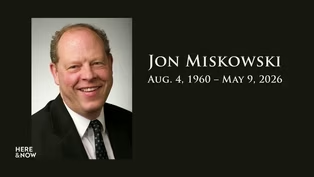
NewThe Legacy of PBS Wisconsin Emeritus Director Jon Miskowski
Video has Closed Captions
Clip: S2400 Ep2444 | 1m 23s | Jon Miskowski, emeritus director of television for PBS Wisconsin, has passed away at 65. (1m 23s)
 New
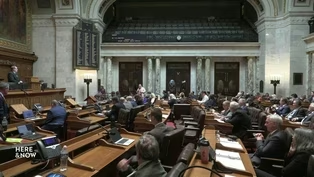
NewWisconsin's Bipartisan State Budget Surplus Deal Falls Apart
Video has Closed Captions
Clip: S2400 Ep2444 | 1m 52s | A bipartisan vote blocked a plan to boost school funds and send checks to taxpayers. (1m 52s)
Providing Support for PBS.org
Learn Moreabout PBS online sponsorship
- News and Public Affairs

Top journalists deliver compelling original analysis of the hour's headlines.

- News and Public Affairs

Today's top journalists discuss Washington's current political events and public affairs.












Support for PBS provided by:
Here and Now is a local public television program presented by PBS Wisconsin