
Tamara Keith and Amy Walter on Lindsey Graham's passing
Clip: 7/13/2026 | 7m 34sVideo has Closed Captions
Tamara Keith and Amy Walter on Lindsey Graham's passing
NPR’s Tamara Keith and Amy Walter of the Cook Political Report with Amy Walter join Geoff Bennett to discuss the latest political news, including what the passing of Sen. Lindsey Graham means for South Carolina and the Senate, Sen. Mitch McConnell's health and Democrats scrambling to replace Graham Platner in the Maine Senate race.
Problems playing video? | Closed Captioning Feedback
Problems playing video? | Closed Captioning Feedback
Major corporate funding for the PBS News Hour is provided by BDO, BNSF, Consumer Cellular, American Cruise Lines, and Raymond James. Funding for the PBS NewsHour Weekend is provided by...
Tamara Keith and Amy Walter on Lindsey Graham's passing
Clip: 7/13/2026 | 7m 34sVideo has Closed Captions
NPR’s Tamara Keith and Amy Walter of the Cook Political Report with Amy Walter join Geoff Bennett to discuss the latest political news, including what the passing of Sen. Lindsey Graham means for South Carolina and the Senate, Sen. Mitch McConnell's health and Democrats scrambling to replace Graham Platner in the Maine Senate race.
Problems playing video? | Closed Captioning Feedback
Where to Watch PBS News Hour
PBS News Hour is available to stream on pbs.org and the PBS app.
Providing Support for PBS.org
Learn Moreabout PBS online sponsorshipGEOFF BENNETT: For more on Senator Lindsey Graham's impact and what his passing means for South Carolina and the Senate, we're joined now by our Politics Monday duo, Amy Walter of The Cook Political Report With Amy Walter and Tamara Keith of NPR.
It's good to see you both.
AMY WALTER, The Cook Political Report: Good to be here.
GEOFF BENNETT: So Lindsey Graham held the South Carolina Senate seat for some 25 years.
Strom Thurmond before him held it for nearly half-a-century.
To what degree does Graham's death mark a real generational turning point for South Carolina politics?
AMY WALTER: Yes, and he was a generational turning point... AMY WALTER: When he was elected in 2002 not just to represent South Carolina after the -- Senator Thurmond, but this was still a state that was transitioning from one that was a Democratic state into one that was going to become a Republican stronghold.
So he was on the front end of that when he was elected in 1994 to the House.
And then, during his tenure, especially in these last 10 years, he really served as a bridge between the two wings of the Republican Party, between the Trump wing and the sort of traditional wing.
I think, when people saw the rift between Senator McCain and Donald Trump in Donald Trump's first term, the assumption was that Lindsey Graham was going to fall into that same camp, right?
These were both interventionists.
They had a very strong belief about the role of America's military and strategic role in the world, and that Graham would join with McCain in being sort of horrified at the direction that the president was taking the party and potentially the country.
But, instead, what Lindsey Graham saw was an opportunity.
And you could make the argument that in some ways he was able to actually make that case, especially on the issue of Ukraine, which, without his voice, it's unclear if this administration would have continued to push money and aid to Ukraine.
So I think what his passing suggests is, he's one of the last of the generation of Republicans left in Congress that were there in an era before Donald Trump.
GEOFF BENNETT: And now, at this point, Tam, there will be a temporary successor, and then there will be an election, as Lisa walked us through the process.
Given Trump's dominance over the Republican Party and South Carolina politics in particular, I think the real question now is not will Graham's successor align with Trump, but what kind of Trump-aligned Republican emerges from this race?
TAMARA KEITH:Yes.
And I think the answer is, whoever it is going to be a reliable vote for Donald Trump and his agenda.
Lindsey Graham has been a reliable vote for President Trump.
And President Trump has a lot of sway when it comes to determining who wins Republican primaries, though I will note that in the governor's race in South Carolina, there was a run-off.
The candidate that President Trump had initially endorsed was looking like she was losing, so he went and endorsed both of them.
So sometimes his power in primaries is more based on his ability to read the room.
AMY WALTER: Yes.
But I would absolutely expect that the president's going to weigh in on who the successor will be.
AMY WALTER: It's not just going to play out in sort of an open environment.
TAMARA KEITH: He weighed in on who the temporary successor would be.
AMY WALTER: That's right.
GEOFF BENNETT: That's right.
That's right.
Well, look, after a month of uncertainty about Mitch McConnell's health, the Kentucky senator said Sunday that another fall had sent him to the hospital.
He issued -- his office issued a statement, and there was this photo of him sitting alongside his wife, the former transportation secretary, with what appears to be the Sunday edition of The Washington Post.
How should politicians balance the legitimate right to medical privacy with the public's right to know whether they're capable of doing the job?
TAMARA KEITH: Yes, so there is no law that says that politicians have to disclose their health issues.
That is also true for the president of the United States, and there's been a lot of focus on that, but that's true in the Senate and the House as well.
And we just had a House member who was gone for three months, four months, without any explanation until he was back.
While there isn't a legal obligation, I think arguably there is a moral obligation.
You're there to represent your voters, and if they don't know where you are, that's pretty significant.
And there's another thing here.
These are public figures.
They in some ways surrender their right to be private citizens when they become public figures representing the public.
GEOFF BENNETT: Amy?
AMY WALTER: Yes, it feels a little bit like the argument would be similar to one you would make at your own place of business.
If you just disappeared, Geoff, for three months and didn't tell anybody why you were gone... GEOFF BENNETT: I hope somebody would ask a couple questions.
TAMARA KEITH: We would ask.
AMY WALTER: First of all, we would be very worried.
But we would also hope that you told someone, maybe in H.R., what was going on.
Now, H.R.
shouldn't tell everybody in the office what exactly is happening, but you should at least be transparent.
And I think that's where people get really frustrated.
It's not so much that, oh, my gosh, somebody is taking time and spending it in the hospital and not telling us exactly what's going on with them physically.
It's that we didn't get any reason to understand that you were gone in the first place.
And that -- I think it becomes a bigger challenge.
TAMARA KEITH: And it foments conspiracy theories, which we have seen in spades, both with McConnell and then with Lindsey Graham.
AMY WALTER: Yes, a hundred percent.
TAMARA KEITH: I think it is notable how quickly his office put out word of the reason, the cause of his death, for this very reason, because, in the absence of information, when there's a vacuum in this current political climate, things really spin up quickly.
GEOFF BENNETT: We've got a couple of minutes left.
You were in Maine this past weekend covering the Maine Senate race.
We've covered the Graham Platner implosion a lot on this program this past week.
What were Democrats in Maine telling you?
TAMARA KEITH: I got a lot from Democrats in Maine, very mixed feelings, mixed.
Some of them are mad at the Democratic establishment for the fact that Graham Platner is out of the race.
Many of them are worried that this process may not lead to a candidate who can sort of recapture that energy or keep that momentum going.
But others remain optimistic that somehow this wasn't about one man, it was about a movement and about progressive policies and about shaking things up.
I think that we'll know in the next two weeks whether the state Democratic Party process is open and transparent enough to end exciting enough to get voters motivated in May.
GEOFF BENNETT: You just answered the question I was going to put to Amy.
AMY WALTER: About are they motivated enough?
GEOFF BENNETT: Well, I was going to ask if Democrats are hampered by all of this, or is there time to reset?
AMY WALTER: I think there is.
I mean, I think there's been so much focus on Platner and this idea of building a movement that we've moved away from the central issue here for the 2026 midterm elections, which is, Democrats are fired up.
They've been showing up in all kinds of states to show up and vote really as a rebuke of Donald Trump.
Maine is a blue state.
It is even bluer now in an anti-Trump moment that we're living through.
They don't need a movement.
They need people to focus this election less about -- making the conversation less about Platner and much more about Trump.
GEOFF BENNETT: Amy Walter, Tamara Keith, thanks, as always.
AMY WALTER: You're welcome.
TAMARA KEITH: You're welcome.
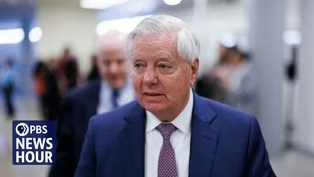 New
NewLindsey Graham's career and influence on American politics
Video has Closed Captions
Lindsey Graham's career and influence on American politics (10m 47s)
 New
NewNews Wrap: Judge says IRS lawsuit filed for improper purpose
Video has Closed Captions
News Wrap: Judge says Trump's lawsuit against IRS filed for 'improper purpose' (6m 21s)
 New
NewNolan Wells' family presses for transparent investigation
Video has Closed Captions
Nolan Wells' family presses for transparent investigation into his death (7m 32s)
 New
New'One Day in September' traces baseball's first All-Star Game
Video has Closed Captions
'One Day in September' chronicles how baseball's All-Star Game was born (7m 2s)
 New
NewTrump says U.S. 'taking over' strait as Iran war reignites
Video has Closed Captions
Trump says U.S. 'taking over the strait' as conflict with Iran reignites (7m 37s)
 New
NewWhat we know about cyclosporiasis outbreak's link to produce outbreak
Video has Closed Captions
What we know about the cyclosporiasis outbreak linked to produce (6m 16s)
Providing Support for PBS.org
Learn Moreabout PBS online sponsorship
- News and Public Affairs

FRONTLINE is investigative journalism that questions, explains and changes our world.
 New Episode
- News and Public Affairs

Today's top journalists discuss Washington's current political events and public affairs.

 New Episode
 New Episode
 New Episode

 New Episode
 New Episode
 New Episode
 New Episode
Support for PBS provided by:
Major corporate funding for the PBS News Hour is provided by BDO, BNSF, Consumer Cellular, American Cruise Lines, and Raymond James. Funding for the PBS NewsHour Weekend is provided by...