
What Supreme Court's SAVE database ruling means for midterms
Clip: 9/25/2026 | 4m 24sVideo has Closed Captions
What the Supreme Court's voter-citizenship database decision means for the midterms
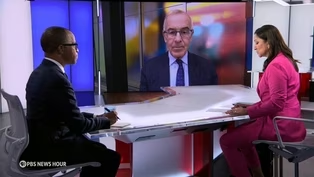
The Supreme Court revived a controversial voter-citizenship database less than two months ahead of the midterm elections. In the ruling, the court sided with the Trump administration, which is seeking to use the Department of Homeland Security’s SAVE database to review state voter rolls for potential noncitizens. Geoff Bennett discussed more with Jessica Huseman of Votebeat.
Problems playing video? | Closed Captioning Feedback
Problems playing video? | Closed Captioning Feedback
Major corporate funding for the PBS News Hour is provided by BDO, BNSF, Consumer Cellular, American Cruise Lines, and Raymond James. Funding for the PBS NewsHour Weekend is provided by...
What Supreme Court's SAVE database ruling means for midterms
Clip: 9/25/2026 | 4m 24sVideo has Closed Captions
The Supreme Court revived a controversial voter-citizenship database less than two months ahead of the midterm elections. In the ruling, the court sided with the Trump administration, which is seeking to use the Department of Homeland Security’s SAVE database to review state voter rolls for potential noncitizens. Geoff Bennett discussed more with Jessica Huseman of Votebeat.
Problems playing video? | Closed Captioning Feedback
Where to Watch PBS News Hour
PBS News Hour is available to stream on pbs.org and the PBS app.
Providing Support for PBS.org
Learn Moreabout PBS online sponsorshipAMNA NAWAZ: Welcome to the "News Hour."
The Supreme Court revived a controversial voter citizenship database today just two months ahead of the midterm elections.
GEOFF BENNETT: In the ruling, the court sided with the Trump administration as it looks to use the Department of Homeland Security's so-called SAVE database to review state voter rolls for potential noncitizens.
Joining us now is Jessica Huseman, editor in chief of Votebeat, which has been covering this issue.
Jessica, it's always great to speak with you.
So walk us through exactly what the Supreme Court did today.
What can the Trump administration and states do today that they couldn't do yesterday?
JESSICA HUSEMAN, Editorial Director, Votebeat: That's a really complicated question to answer because of the timing of the November election.
So the Supreme Court stayed a lower courts of June ruling that blocked the 2025 modifications of the SAVE database that allowed states to use them to mass-check people for citizenship status on their voter rolls.
And so states can begin to do that.
The problem for the Trump administration is that we are in a 90-day period required by the NVRA, which is a federal voting law, that prevents people from being removed from the rolls ahead of a federal election.
So while this is really going to be a sea change for election administrators going forward, I don't think voters will see any real effect right now for this election, given that -- given that parameter.
GEOFF BENNETT: And this database, this SAVE database, it wasn't originally designed to police voter rolls.
How has the Trump administration transformed it?
And why has this become a central part of its election strategy?
JESSICA HUSEMAN: Right, absolutely.
I think that people are really confused about what the SAVE database is, what's in it, what it was created for.
And really this is a database to track noncitizens or to sort of have an accounting of noncitizens in the country that DHS knows about, right?
And that's a pretty clear distinction between I think what people think that it is, which is a magical database with every noncitizen who happens to be in the country living on it, right?
That is not the list that exists.
And even the list that they're using have significant problems.
We are seeing pretty bad mismatch problems.
We saw that repeatedly in Texas, for example.
So it's not a perfect database.
And Trump has allowed states to use this to batch search people who are on the voter rolls.
Previously, states could only search one person at a time.
Now they can use it much more broadly.
And the database is tied into several other databases that DHS maintains.
So, theoretically, it's a much more powerful tool than it used to be.
The problem is that it's still returning a lot of errors.
GEOFF BENNETT: Well, on that point, Justice Ketanji Brown Jackson, she warned in her dissent that states might cancel the voter registrations of at least some recently naturalized citizens.
So how does an eligible voter get wrongly flagged by this system?
And has that actually happened before?
JESSICA HUSEMAN: It has happened and it's happened frequently.
We've reported about it in Texas.
So I think that people assume that government databases all talk to each other and they automatically track you through your citizenship process.
It does not, right?
This is a database that is largely maintained by human beings who have to enter the information into the database on time and when required of them and as you expect them to.
And we know from history that that doesn't often happen.
I think that it's important for people to know that this isn't the last check, right?
If your county chooses to use this process, if your state chooses to use this process, your county election administrator is still the one that is ultimately responsible.
for removing you from the rolls.
And Votebeat knows from our reporting that these county clerks tend to be much more careful with these matches than the federal government or even many state governments are.
And they are doing those second-level checks to make sure that people who are flagged are not unnecessarily removed in most cases.
GEOFF BENNETT: Jessica Huseman, you make the confusing crystal clear.
Thanks for helping us make sense of all this.
We appreciate it.
JESSICA HUSEMAN: Thanks so much.
GEOFF BENNETT: And, moments ago, the Supreme Court issued another ruling striking down the Trump-backed congressional maps in Missouri with weeks until the election.
The order blocks a map that could have added another Republican district.
Brooks and Capehart on Trump's warm welcome for China's Xi
Video has Closed Captions
Brooks and Capehart on Trump's warm welcome for China's Xi Jinping (10m)

GOP's bet on Texas Latino voters could backfire in midterms
Video has Closed Captions
GOP's big bet on Texas Latino voters could backfire in midterms (5m 50s)

Health care costs a concern for voters ahead of midterms
Video has Closed Captions
Health care costs a major concern for voters ahead of midterms (6m 34s)
Mexico's foreign secretary on Trump and U.S. trade talks
Video has Closed Captions
Mexico's foreign secretary on Trump, cartel violence and U.S. trade talks (6m 13s)

News Wrap: Xi wraps up 3-day state visit with Trump
Video has Closed Captions
News Wrap: Xi wraps up 3-day state visit with Trump (6m 30s)

Syrian dancer escaped ISIS and found freedom through ballet
Video has Closed Captions
Syrian dancer reflects on escaping ISIS and finding freedom through ballet (5m 37s)

Wrongfully detained journalist still jailed in Iran
Video has Closed Captions
Wrongfully detained Iranian American journalist remains jailed in Iran after 2 years (6m 6s)
Providing Support for PBS.org
Learn Moreabout PBS online sponsorship
- News and Public Affairs

Today's top journalists discuss Washington's current political events and public affairs.
 New Episode
- News and Public Affairs

FRONTLINE is investigative journalism that questions, explains and changes our world.
 New Episode
 New Episode
 New Episode


 New Episode


 New Episode
 New Episode
Support for PBS provided by:
Major corporate funding for the PBS News Hour is provided by BDO, BNSF, Consumer Cellular, American Cruise Lines, and Raymond James. Funding for the PBS NewsHour Weekend is provided by...