
U.S. begins naval blockade after Iran peace talks fail
Clip: 4/13/2026 | 5m 15sVideo has Closed Captions
U.S. begins Strait of Hormuz naval blockade after Iran peace talks fail
The U.S. began a blockade of Iranian ports on Monday, less than two days after a first effort at peace talks between the Americans and Iran failed in Pakistan. White House correspondent Liz Landers reports.
Problems playing video? | Closed Captioning Feedback
Problems playing video? | Closed Captioning Feedback
Major corporate funding for the PBS News Hour is provided by BDO, BNSF, Consumer Cellular, American Cruise Lines, and Raymond James. Funding for the PBS NewsHour Weekend is provided by...
U.S. begins naval blockade after Iran peace talks fail
Clip: 4/13/2026 | 5m 15sVideo has Closed Captions
The U.S. began a blockade of Iranian ports on Monday, less than two days after a first effort at peace talks between the Americans and Iran failed in Pakistan. White House correspondent Liz Landers reports.
Problems playing video? | Closed Captioning Feedback
How to Watch PBS News Hour
PBS News Hour is available to stream on pbs.org and the free PBS App, available on iPhone, Apple TV, Android TV, Android smartphones, Amazon Fire TV, Amazon Fire Tablet, Roku, Samsung Smart TV, and Vizio.
Providing Support for PBS.org
Learn Moreabout PBS online sponsorshipAMNA NAWAZ: Welcome to the "News Hour."
The U.S.
began a blockade of Iranian ports today, less than two days after a first effort at peace talks between the Americans and Iran failed in Pakistan.
White House correspondent Liz Landers begins our coverage.
LIZ LANDERS: Today, in the Strait of Hormuz, it was the U.S.
Navy that said it will enforce a blockade, a choke point for roughly 20 percent of the world's oil now a bargaining chip caught in the middle of an impossible negotiation.
The U.S.
said it would block all ships entering or leaving Iranian ports.
President Trump issued a direct threat, warning that if any Iranian vessel comes close to the U.S.
blockade, it will be -- quote -- "immediately eliminated" and today said there will be no deal until Iran gives up its highly enriched uranium.
DONALD TRUMP, President of the United States: If they don't agree, there's no deal.
There'll never be a deal.
Iran will not have a nuclear weapon, and we're going to get the dust back.
We'll get it back.
Either we'll get it back from them, or we'll take it.
LIZ LANDERS: The escalation follows the failure of 21 hours of marathon talks in Islamabad this weekend.
The negotiations were meant to turn a fragile cease-fire into a broader agreement.
Instead, both sides walked away, blaming each other.
J.D.
VANCE, Vice President of the United States: The bad news is that we have not reached an agreement.
And I think that's bad news for Iran much more than it's bad news for the United States of America.
LIZ LANDERS: Vice President J.D.
Vance said the ball is now in Iran's court.
J.D.
VANCE: We go back to the United States having not come to an agreement.
We have made very clear what our red lines are.
And we leave here with a very simple proposal, a method of understanding that is our final and best offer.
We will see if the Iranians accept it.
LIZ LANDERS: But Iranian Foreign Minister Abbas Araghchi said Iran negotiated -- quote -- "in good faith," but when the sides were just inches away from a deal, the U.S.
turned to what he called maximalist demands and imposed a blockade instead.
Iran's speaker of Parliament reacted to the U.S.
blockade by trolling the president, showing a map of gas prices near the White House in Washington, adding -- quote -- "Soon, you will be nostalgic for $4 to $5 gas."
IAN RALBY, President, Auxilium Worldwide: Unfortunately, this is an escalation by the United States by invoking the doctrine of blockade, which is a law of naval warfare construct.
So this is going to be perceived as aggression against Iran amid this cease-fire.
And so there will be some form of retaliation.
LIZ LANDERS: Ian Ralby is a founder and CEO of Auxilium Worldwide and focuses on maritime security.
He said the blockade could become an open-ended military commitment with global economic consequences.
IAN RALBY: If the American blockade actually does function and it does suspend any movement through the Strait of Hormuz, as it is likely to do, we're actually going to see a further increase in price, because what is happening is that the limited trickle of oil that was coming out, roughly $3.5 billion since the start of this conflict, to largely the Asian markets will become zero.
LIZ LANDERS: Ralby cautioned that the scope of the blockade and how it will be imposed is still unknown, but said it may not hurt Iran as much as the U.S.
hopes.
IAN RALBY: The Iranians are probably going to find ways not only to adapt economically, but also adapt militarily and try to create concomitant harm for everybody else.
So they're likely to push back in different ways.
And that could mean attacking neutral vessels.
LIZ LANDERS: Today, China also came out against the blockade.
Chinese Foreign Minister Wang Yi said it is not in the common interests of the international community and urged for a comprehensive and lasting cease-fire.
The United States' partner in this war, Israel, was not part of recent negotiations, as Pakistan doesn't recognize the state of Israel.
But Israeli Prime Minister Benjamin Netanyahu said the U.S.
and Iran failed to reach a deal because Iran did not open this strait and refused to give up its right to enrich uranium.
BENJAMIN NETANYAHU, Israeli Prime Minister (through translator): Yesterday, I spoke with Vice President J.D.
Vance.
He reported to me in detail, as officials of this administration do on a daily basis.
The central issue on the table from the perspective of President Trump and the United States is the removal of all of enriched material and ensuring that there will be no enrichment in the years ahead, which could be decades of no enrichment inside Iran.
That is their focus.
And, of course, it is also important to us.
LIZ LANDERS: Iran said it will not open this strait until there's also a cease-fire in Lebanon, which it says was part of the cease-fire agreement.
But since the cease-fire in Iran, Israel has intensified its attacks on Lebanon, attacking 100 sites in 10 minutes last week, killing nearly 400 people.
And the search for remains continues.
Hezbollah has also been firing rockets into Northern Israel.
And, yesterday, Netanyahu met Israeli troops in Lebanon and vowed to continue the war.
In Tyre in Southern Lebanon, this family's incomprehensible grief.
They lost their baby girl, Talin (ph), killed in an Israeli strike during her father's funeral.
Talin's elder sister, 7-year-old Aleen (ph), survived, but with severe burns.
And while world powers debate escalation, here, the war's reality is measured not in strategy, but in lives lost.
For the "PBS News Hour," I'm Liz Landers.
 New
NewEvan Shapiro and Geoff Bennett on the future of media
Video has Closed Captions
Evan Shapiro and Geoff Bennett explore the future of media on 'Settle In' (3m 39s)
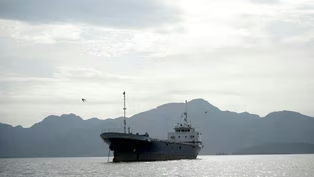 New
NewHow the U.S. blockade could pressure the Iranian regime
Video has Closed Captions
Mideast experts discuss how the U.S. blockade could pressure the Iranian regime (8m 58s)
 New
NewHow the vote to oust Orbán could have global implications
Video has Closed Captions
How Hungary’s vote to oust Viktor Orbán could have global implications (10m 8s)
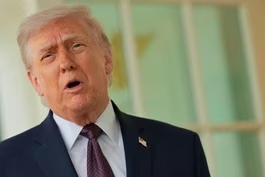 New
NewNews Wrap: Judge dismisses Trump's lawsuit against WSJ
Video has Closed Captions
News Wrap: Judge dismisses Trump's lawsuit against WSJ for story on Epstein ties (3m 13s)
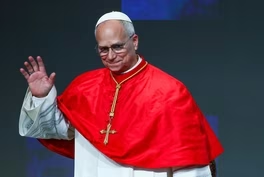 New
NewPope Leo vows to continue speaking out after Trump clash
Video has Closed Captions
Trump clashes with Pope Leo, who vows to continue speaking out against war (4m 59s)
 New
NewRep. Swalwell resigning after sexual assault accusations
Video has Closed Captions
Swalwell resigning from Congress after sexual assault accusations (7m 52s)
 New
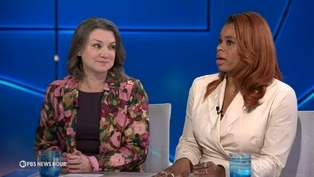
NewTamara Keith and Jasmine Wright on Trump, Pope Leo feud
Video has Closed Captions
Tamara Keith and Jasmine Wright on Trump's feud with Pope Leo (8m 48s)
Providing Support for PBS.org
Learn Moreabout PBS online sponsorship
- News and Public Affairs

FRONTLINE is investigative journalism that questions, explains and changes our world.

- News and Public Affairs

Today's top journalists discuss Washington's current political events and public affairs.












Support for PBS provided by:
Major corporate funding for the PBS News Hour is provided by BDO, BNSF, Consumer Cellular, American Cruise Lines, and Raymond James. Funding for the PBS NewsHour Weekend is provided by...