
Cuba Censors José Lezama Lima
Clip: Season 2021 Episode 1 | 7m 3sVideo has Closed Captions
José Lezama Lima grew lonely as the Cuban government silenced him for "Paradiso."
"Paradiso" marked José Lezama Lima as a writer too independent to be trusted by a government that required full compliance. Cuba censored his work as a result of the novel and suspicions that he was gay. Despite being forbidden in his own country, the novel was translated and revered worldwide. The poet grew hopeless as attempts to travel abroad were thwarted by denied exit visas.
Problems playing video? | Closed Captioning Feedback
Problems playing video? | Closed Captioning Feedback
Cuba Censors José Lezama Lima
Clip: Season 2021 Episode 1 | 7m 3sVideo has Closed Captions
"Paradiso" marked José Lezama Lima as a writer too independent to be trusted by a government that required full compliance. Cuba censored his work as a result of the novel and suspicions that he was gay. Despite being forbidden in his own country, the novel was translated and revered worldwide. The poet grew hopeless as attempts to travel abroad were thwarted by denied exit visas.
Problems playing video? | Closed Captioning Feedback
Where to Watch VOCES
VOCES is available to stream on pbs.org and the PBS app.
Buy Now
Providing Support for PBS.org
Learn Moreabout PBS online sponsorship-Whenever a quotation from a poem of Lezama's was part of an essay, the censor would come in and would actually strike that reference and you would not be able to cite or even mention the name of Lezama in writing.
[music] [music] -Dear Eloi, I received a letter informing me that Gregory Rabassa has completed the translation of Paradiso and that the book will soon be ready for publication.
[music] [music] -Dear Eloi, the years are falling on me.
I just turned 62 and still await the day when I will see you again.
I am here alone with Maria Louisa, surrounded by loneliness with only more loneliness on the horizon.
-Dear Eloi, the Mexican government invited me and Maria Luisa on a visit but we could not solve the problem of an exit visa.
The University of La Aurora in Cali, Colombia invited me to the fourth congress of Hispanic American narrative.
The tickets arrived in Havana, but I was not granted an exit permit.
I received another invitation to speak at the Ateneo of Madrid, I always accept, but the result is predictable.
-Obviously, someone high up determined that it was better not to let this guy travel abroad for fear that either he would bad-mouth the revolution, or he would be a flight risk.
-Dear Eloi, it brings me great joy that the English edition of Paradiso is going well.
Some of the reviews that you sent me are well-written.
Others reveal confusion among North American intellectuals.
They speak of Garcia Marquez, which is all they know and who has nothing to do with my work.
-Countries promote their own writers, and such a writer is going to Italy or such a writer appears in a conference.
That was so constant during the boom except with Lezama.
We didn't see him.
-August 1974.
Dear Eloi, I am at a moment in my life when I need to travel, see a different landscape.
The resonance of my work abroad would allow me to do just that but the Ananke, the fatality is always there with its eye of a cyclops fixed upon me.
[music] [music] -Dear Eloi, I have to stay in my little house as long as God wills it.
I am bored and tired.
I write, sometimes, a little poem and that still keeps me on my toes.
[music] [music] [music]
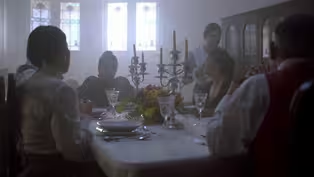
'Paradiso' Stirs Scandal Amid Glory Upon Release
Video has Closed Captions
Clip: S2021 Ep1 | 5m 30s | In his novel "Paradiso," José Lezama Lima revealed secrets that mirrored his own life. (5m 30s)
Video has Closed Captions
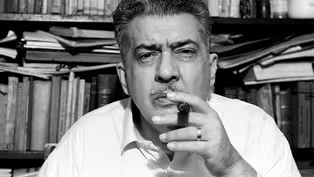
Preview: S2021 Ep1 | 30s | "Letters to Eloisa" depicts the life of Author José Lezama Lima. (30s)
Providing Support for PBS.org
Learn Moreabout PBS online sponsorship







Support for PBS provided by: