
USDA Report Lifts Grain Markets as Cattle Industry Risks Grow - Market to Market - August 14, 2026
Season 51 Episode 5152 | 26m 44sVideo has Closed Captions
Double the commodity market analysis with Jeff French and Ross Baldwin.
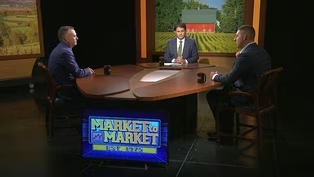
On this edition of Market to Market ... A government report provides some August fireworks. A late summer commodity discussion on crop size and animal inventory. Double the commodity market analysis with Jeff French and Ross Baldwin.
Problems playing video? | Closed Captioning Feedback
Problems playing video? | Closed Captioning Feedback
Market to Market is a local public television program presented by Iowa PBS
USDA Report Lifts Grain Markets as Cattle Industry Risks Grow - Market to Market - August 14, 2026
Season 51 Episode 5152 | 26m 44sVideo has Closed Captions
On this edition of Market to Market ... A government report provides some August fireworks. A late summer commodity discussion on crop size and animal inventory. Double the commodity market analysis with Jeff French and Ross Baldwin.
Problems playing video? | Closed Captioning Feedback
Where to Watch Market to Market
Market to Market is available to stream on pbs.org and the PBS app.
Providing Support for PBS.org
Learn Moreabout PBS online sponsorship>> Coming up on Market to Market, a government report provides some August fireworks.
A late summer commodity discussion on crop size and animal inventory.
Double the commodity market analysis with Jeff French and Ross Baldwin.
Next.
>> I wouldn't be here without my customers.
>> Yeah, I'd like to thank the customers.
They're.
They're very dear to our hearts.
>> It's about the people that you're working with and the relationships that you have.
>> Thank you, thank you, thank you.
>> Thank you from the bottom of my heart >> [MUSIC] >> Tomorrow, for over 100 years, we've worked to help our customers be ready for tomorrow Trust in tomorrow.
Information is available from a Grinnell Mutual agent today.
>> Family owned and operated for more than 60 years.
Sukup Manufacturing is a full service provider of grain handling, storage and drying equipment, helping farmers feed and fuel the world.
>> Support for Market to Market has been provided by a bequest from Philip Leeds of Alta, Iowa, in recognition of public television's commitment to agricultural programing.
>> Market to market is made possible in part by a grant from the Corporation for Public Broadcasting.
>> This is the Friday, August 14th edition of Market to Market, the weekly Journal of Rural America.
>> Hello, I'm Paul Yeager.
Americans cut back their spending in July by the largest amount in a year.
Retail sales fell 6/10 of a percent last month, the biggest drop since May of 2025.
Inflation did cool in the heat of summer, as the producer price index was flat for the month.
The year over year reading for the PPI was 4.7%.
The price for consumers was up a 10th of a percent, while the annual rate added 3.7% to the prices that you and I pay Wednesday's Wasde report pushed grains higher and meats lower.
Secretary Rollins has proposed opening the border to cattle imports.
Wars in Iran and Ukraine continue without resolution and there is a drought in Europe as well as in the West.
We brought two of our regular market analysts for some perspective on these volatile commodity markets.
Jeff French is founder of Ag-Hedger.
Ross Baldwin is a hedging strategist with AG market.net.
We'll see you both in just a minute.
Hang on for a moment because we need to start by taking a look at the numbers.
Because USDA reduced corn and soybean yield, but increased acres for commodities.
The report also revealed a lower corn carryout and higher soybean ending stocks for the trading week that ended August 14th.
The nearby wheat contract gained $0.35, and the September corn contract added $0.20.
China kept the demand side of the ledger moving in a bullish direction for U.S.
Producers in the soy complex.
The November soybean contract well, it found $0.16 and September meal improved $1.30 per ton.
December cotton expanded by $0.30 per hundredweight.
August class three milk futures put on $0.22.
The livestock Qom.
>> Complex was lower October.
Cattle lost 600 40.
September feeders cut 1068 and the October Lean hog contract sold off $0.48.
In the currency markets, the US dollar index rose 14 ticks.
September.
Crude oil surged higher by 412 per barrel.
Comex gold gained 34.
40 per ounce and the Goldman Sachs Commodity Index added more than 27 points to settle at 68932.
Here now to lend us their insight on these and other trends, a regular market analyst, Jeff French and Ross Baldwin Ross.
Hold on for a minute.
Got to start with Jeff because Jeff at the Iowa State Fair, you're going to be the hero in the barns this week because you made the markets go higher.
Or was it USDA?
Tell me why this was ended up being such a surprise.
>> Well, I don't necessarily mean it was a surprise.
I mean, more acres, a little bit of a surprise.
Demand.
More exports.
You know, we thought that was coming.
You know, for a while the exports have been very strong.
But the rally actually began Tuesday night when Ukraine sent 500 drones into Porto-Novo and Russia and pretty much took out the biggest grain terminal in Russia, in the Black Sea.
So the rally began.
Then we get the numbers and take another leg higher up 20 on the day, above the 100 day moving average for the first time in three weeks.
Good action.
And then a really good strong close there on Friday.
So the charts look good.
But it is headline driven.
The 1.6 billion bushel carryout here for next year is snug, and it probably keeps a bit under this market on until something changes here.
>> The snug carryout really kind of will stick with traders for a while.
I mean that's going to be in the algorithms.
And what is going to free that number to move us one way or another.
>> Absolutely.
It's going to keep with us.
And in the algorithm, what changes it.
Number one is demand.
Does demand cool down.
We don't foresee that.
And then if they do increase the yield I mean this is the August report.
We've had good rains this week throughout the central Corn Belt.
Is it beneficial or does it hurt.
I think that's an argument depending on where you're at.
But you know, if you look at history and you get a lower August yield estimate compared to the July, there are years if the crop ratings get better, there are years that the yield goes up.
But we'll just have to see what brings us.
But watch those crop yields, because that will tell us what direction we're going.
>> You said we're in a headline driven market is one of those headlines.
Whether.
>> Yes.
No question about it.
But we're in July or excuse me, we're in August and we're getting really good rains again.
I think it's more beneficial right now, especially on the bean complex.
But yeah, you know, history shows us you can add yield even in corn with, with, you know, with this much rain that we're getting throughout the states.
>> Well, we've got video right now of a system, Ross, that moved across the country.
It is a system that caused a lot of flooding in a lot of places, put a lot of acres in challenging areas, pasture conditions, always part of the story from where you sit, you can answer whichever way you want.
Weather impact a bigger deal this week or USDA.
On the grain side of this report.
>> I would say the USDA was just because the the numbers that it gave us, especially the friendly numbers on the corn side, it is what sets the stage moving forward, because ultimately you go back to the one.
Six carryout, or you look at it from a stocks to use standpoint, it's a 10.1% stocks to use.
It's pretty tight.
And in my opinion, there's just very little reason to get very negative corn.
Obviously we're heading into harvest.
So that's always going to create a little bit of a headwind.
The weather, like Jeff said, weather this time of the year, it can still add to the corn yield.
I'm not saying it's as big as what it would have been if the rains happened 30 days ago, but it still adds to it.
But you look at corn, I mean, there's just not much of a reason to get to negative corn.
And I think a lot of it's because of the numbers the USDA gave us.
>> You are in an area of Iowa that has been dryer.
Some of your friends up there, I hear from that say, we missed it.
We missed it.
Did you finally catch something this week?
>> Correct.
We've had very good rains here the last couple days, so we've had, I would say a lot.
A lot of spots have had 3 to 4in of rain.
Extremely good.
Good for the pastures like you brought up, but from a soybean standpoint, very beneficial.
The beans, corn, it'll really help the corn from going backwards further with what we were looking at.
No question it will help with the fill.
There's there's producers that I work with that are they're optimistic around what it means for their corn crop and the yield potential.
But there's, there's places where, yeah, the sandy spots have showed up.
They're spots that have, you know, they've obviously burned up.
But I would say that it's a wide range there.
There's spots that are going to be 200 on the lower end, if that.
I mean, there will be some spots that are a little bit worse, but I would say a good average of 200 on the lower end.
And if you're in an area that's got good dirt and are part of the country, you probably still got corn that can do.
>> 250 But Jeff, when you go a little further west of where Ross is in northwest Iowa, you get into Nebraska and South Dakota, that's a different story.
In fact, they're probably screaming at the TV right now saying, we're so bullish with all this rain.
How's the market factor?
That story over there?
>> Yeah.
No, they it is a case of have and have nots and they haven't got it.
You go south from Texas all the way up to North Dakota.
And it's a very distinct line where they just have not caught any of the rains.
And we'll see.
I mean, it's just one of those things where we'll have to see what happens here in the next 30 days.
But the rains right now, at least in the central and the east, I think it outweighs more beneficial.
>> All right.
Let's go to wheat for a minute, because you mentioned the situation between Russia and Ukraine.
We've been talking about European challenges.
That's also impacting the corn market.
Walk me through the U.S.
Producer right now trying to make sense of these headlines a few time zones away.
>> Well, I mean, it's very fluid because it happens at the night.
I mean, and you have you have two of the biggest wheat exporters in the world, and you have essentially the Black Sea and now even the Baltic Sea that have been, you know, pretty much shut down.
You have Ukraine right now that is trying to export as much as possible to get ready for corn harvest.
There's an estimated 30 million metric tons of corn, wheat and oil seed that needs to be exported.
And that's pretty much stopped on the on the sea.
Now they are trying it on rail, but it's, you know, they can only do about 50% of capacity.
So the headlines are, you know, if you got good value, sell into them because this is very fluid.
This stuff can stop, you know, in a heartbeat.
But we'll have to see.
But I think you sell into some here and look to reopen with a December call option.
>> Is the wheat market to a point.
It's standing on its own right now because there was an argument made that maybe Wednesday's report, some of the movement, some of last week's movement was on the coattails of others.
>> You know, I think the wheat is definitely leading us here right now.
I mean, it's the headline driven risk.
It is.
You know, it's corn has fallen it somewhat.
You know, you had wheat up $0.30 here today and corn was up eight, nine, $0.10.
So I think it does help.
They'd like to run together.
But yeah, it's, it's one of those things where, you know, we could continue here.
I mean, the funds were short coming into this week and I think you saw that run up.
You saw a lot of short covering.
We'll see if they want to get long from here.
>> The easy line would be to say did the funds get caught on this report?
There was some sentiment going into Wednesday of be prepared for this lower.
Be prepared for this lower.
And then we went higher.
Somebody was clearly talking to analysts and speaking was that the funds.
>> Well, I mean the funds were actually long going.
They were long corn going into this report.
So they were betting for higher prices.
Now the action.
Did you know it looked like there was some shorts that were definitely blown out of it?
But yeah, I mean, they, they were long and looking for higher prices.
And currently they sit probably long, around 200,000 contracts.
>> Ross.
What disrupts the trend?
Now that was established this week for corn.
>> For for corn, like Jeff said earlier, it would be a demand situation.
And it's difficult today to really envision much in the way of, you know, a major demand disruption.
I don't see that today.
On the corn side of things, but that's really one of the only things that could come out of it.
Honestly, what I think about or what we talk about is with a one six carryout, looking right around there for corn watch yield, there's still a long ways to go.
If yield would bump up a little bit, that number changes, but we still very likely are on the path to stay snug on corn.
And the big question is always what if you see China, someone step in and buy us corn?
You honestly, maybe there could be an upward demand driver versus a downward demand driver for corn.
So where I'm at is I think corn prices are well supported down here.
And the risk is more to the upside today than what it is to the downside.
>> Okay.
So part of what we said in the open here, Jeff, was it felt like an abacus.
And so it's a question here.
I need us to roll.
Let's go Joel in Minnesota because it feels like there's a little bit of math always going on with one of these reports.
And one of the theories.
In fact, it was talked about to me just this morning out at the Iowa State Fair.
What's the story on these phantom acres and how they show up in reports?
>> Well, now it's two years consecutive in the August report that they've.
>> The FSA acres.
You know, it was a real shocker last year.
You know, they gained 2.1 million acres of corn on the planet side this year, gained 1.3.
You know, and change about 1.4 million acres on both corn and beans.
But yeah, it looks like they're coming out of, you know, wheat down in the southeast.
And some cotton acres as well.
But the market was talking about it.
So I don't think it shocked as many as what we were expecting.
>> Soybeans get lost in the shuffle here in this.
>> You know, a little bit.
I mean, wheat in corn definitely dominated the week.
But you know, the the bean number was, you know, pretty neutral.
I mean, 320 million bushel carryout can be tight, especially if China comes in and secures the 25 million metric tons that they have signed on to It's estimated that they've secured about 8 million metric tons already.
And it's estimated that they'll secure about 15 million metric tons when Trump and XI meet in the end of September.
They've been in the market, you know, pretty much every day this week.
You know, a couple cargoes here, a couple cargoes there.
They need to start speeding up some of their purchases if they're going to get to that 25.
Million metric tons.
>> But were at.
When we saw the chart just there a moment ago, that daily moving average pick one, 20, 40, 100, 200, whatever it is, we're kind of hanging in that area.
So is that more of a technical sign to you?
>> I'm looking at $12.
I mean, okay, you see after the report we go up to 1198 and then we break hard $0.25.
You know, I look at $12 off the combine.
I think that's a great place to be making some sales.
Again.
Look to may get through southern look get through Brazil whether with a call option there.
>> Ross we have put off what is the headline been for you has been the last 2 or 3 weeks.
This report will get cattle on feed next week, but cattle reports have been.
Are we in a spot right now where it's kind of.
Oh goodness.
What next?
Just come on my phone.
To what headline might drive us lower.
>> It's really what it feels like with the Tyson announcement here yesterday at 3:00, when they announced they were closing, Joslyn selling the Pasco facility.
So that's really.
>> And it happened the same day that Souderton was going offline, that JBS had announced that a month ago.
But it was on the same day, and Jocelyn is already dark.
That's the the crazy part in all of it is, is they made the announcement yesterday and Jocelyn is already dark and it's done.
So it does feel like what is next type of environment that we're in.
But on the same token, cattle did live.
Cattle deferred months, only closed about a dollar lower.
Feeders closed 3 to 4 lower.
Somewhere around there, maybe two on the August contract.
But honestly, I'd call it a victory for the news that we were dealt with to end the week here.
And, you know, moving forward, we've thrown so much bearish news at this market.
It does kind of feel like a relief to get some of it past us right now.
But there's no question it's a headwind as we move forward.
>> Those of us who might not understand every single I mean, we always hear about this report, this factory, this plant, this processing plant, whatever it is that goes offline.
Johnson's not the biggest in the in the portfolio, but each time there is one of those closings, what's the average person need to know about why that is so important.
>> To me?
The significance with these closings that we have seen is any time that you lose a major Packer closing these facilities, it's not good for the long term structure of the market.
So when I think about it, you had Tyson close Lexington this past January, and now they've closed.
Joslyn, you've had JBS closed Souderton.
It's difficult to find other participants that are going to step in to this marketplace.
There's always been so much chatter around people yelling at the top of their lungs that we've got to break up the big four.
And I've always my words that I've always said is, careful what you wish for, because this is this is not a normal business that these four major players are trying to run on a day in, day out scenario.
So when I see the these majors that are they're exiting the business.
So if you look at Tyson, since the beginning of the year, Tyson with Lexington going down and Amarillo going to a single shift, which they said they're going to bring Amarillo back up to full capacity.
But taking Joslyn off and selling Pasco, it's about 40% of Tyson's capacity, less that they have today than what they started the year with.
That is significant.
When you think of a of a Tyson.
So the real concerning part also right now with Souderton going offline.
And yes, they did make the announcement this week that they're turning Souderton into a value added processing facility.
It'll keep 400, but it's not going to be a slaughter facility.
So you take Souderton out of the mix and you take Joslyn out of the mix.
Souderton was around 2000 head.
Joslyn is 3100.
You take those out of the mix and it's a major problem for the cattle producers out in the east east of the Mississippi.
So really them guys out there is who really got the biggest gut punch, I would say on the week, because you start losing that kind of capacity.
It's a trickle down effect to everyone.
Your cow calf producers, your backgrounders, your feedlots, your fed cattle.
So that's a it's a tough one to swallow.
It's not something that's going to have any immediate impact, say, over the next few months, immediately.
It's not good, but longer term, you start talking 5 to 10 years down the road.
It looks different out in the east.
>> Do you get the sense that the worst is behind us, though?
>> It's hard to say.
I mean, you just as a as a producer, you want as much competition for those guys battling over your cattle, you know?
Yeah, we came off the lows here on Friday.
I think we had a little short covering.
You know this was well telegraphed.
I mean somebody knew that this was coming.
I mean we broke hard Wednesday.
Not a good look to make new lows for the year.
And with the S&P at all time highs.
But yeah it could be a major you know sell the rumor buy the fact we've seen it many times here in this cattle market.
But the charts and technically it does not look good.
>> And you kind of got a two fold situation here because I don't think the worst is behind us for the cattle industry from a pricing standpoint.
And the big picture, because the cycle is still not over.
So as the cycle eventually gets over, that is when the worst is still ahead of us.
But right now, over the near term, the bounce that we had, the crazy part is, is you've had Fort Morgan that's been offline since May 20th.
Cargill's plant there where it's been locked out due to negotiations that plants 4500 head of day.
So they're going to a vote again on Monday.
They rejected the last vote.
They're going to go to a vote on Monday.
There's a lot of optimism that the vote could pass.
And if you bring Fort Morgan back online, that's 4500.
That's actually been idle over the last 40 days.
Call it 45 days.
Well, that's already that's a 1400 head more than what Jocelyn was killing.
So the net net effect, if you take get Fort Morgan back online.
And I don't know when Amarillo adds that shift back, but those two plants Amarillo going adding the shift and Fort Morgan coming back online.
Those two plants combined with that is actually a net increase versus Jocelyn and Souderton.
I'm not trying to paint a bullish picture long term.
Long term.
I will always say when you lose packing capacity, it is not good for the market that you're in.
But short term, we still have extremely tight supplies right now, and we are going to get some packing capacity back online here.
>> The picture behind you, because I sit and look at it while you're talking.
If I'm someone who's got those types of cattle sitting in my in my field or my lot, or I'm thinking about putting them in my field or my lot, is there optimism for somebody who's trying to, whether it's background feed or whatever right now, somebody a little further down the line, where's my indigestion?
And is it justified in what the news you're talking about?
>> The big winner has been the cow calf producer.
And and I still have a friendly outlook for the cow calf producer as we head out through the end of this year and even out into 2027, the cow calf guy has very good potential.
Still out here.
Now the risk gets to be is what these bred heifers and replacements have cost.
And if you're sitting on a lot of those, I would definitely have a little bit of heartburn there.
Optimism from the cattle feeding standpoint.
That's a tricky one.
The the swaps have been extremely negative because feeder cattle have been so high priced versus what fats have done.
But as you get the border reopened and and you start to pressure feeder cattle, then there will be optimism that builds across the cattle feeding sector of it, the Backgrounders.
They're looking at a tough situation right now, too.
But as feeder cattle, feeder cattle start to pull back as a result of maybe the border reopening, there will be optimism in feeder cattle.
>> I have to write that down.
That's a huge thing.
We need to talk about.
Market Plus I just a few seconds here on the hog market.
If I don't mention what's going on there, because they haven't been able to capitalize, there was a little rally and then it went away.
It fizzled.
>> The biggest problem for hogs right now is just global pork supplies.
And you've seen it in China, Brazil, Europe and even the US.
We've seen hog slaughter pulling back here over the last few weeks.
But at the end of the day, it's a supply situation that we have to deal with.
>> Okay.
Last thing.
>> August Hogs went off the board today.
Seasonally, October will be the front month.
Monday seasonally, October typically works lower coming into the front month.
>> All right.
Very good.
I appreciate your time.
That's Jeff French.
That's Ross Baldwin.
We're just getting started.
Market Plus.
We have to talk about a whole lot more.
I got great questions.
Thank you gentlemen.
Both.
>> Thanks, Paul.
>> Thank you.
>> Paul.
All right.
You have been watching the analysis portion of our program.
In a moment, we will continue our discussion and call it Market Plus.
So here's how you find it.
You search Market Plus with Jeff French and Ross Baldwin wherever you get your podcasts.
You can also go to our website at Markettomarket.org to listen.
The Market Insider Newsletter is approaching its second birthday.
That means you can get on the ground floor of the behind the scenes information from this program and other events that happen in the production of Market to Market.
Subscribe now on our website of Markettomarket.org.
A new edition comes out Monday morning and it will explain what you are about to see here.
At the end of our 51st season next week, we are going to look at the land battle brewing over data centers.
Thank you so much for watching.
Have a great week.
>> [MUSIC] [MUSIC] >> For me, the rain, my darling.
Fight me the rain.
Fight for me.
The crystal pools that fall upon the lane.
And I'll fly for you.
The rainbow in a million hearts of gold.
Fight for me now baby.
For I am too old.
I am too old.
>> [MUSIC] >> To fight for me.
The sun, my darling.
Fight for me.
The sun.
Fight for me.
The light that falls with day has just begun.
And I'll buy for you a shadow to protect you from the day.
Fight for me now baby, before I go away.
>> [MUSIC] >> Fight for >> [MUSIC] >> me.
The Robin darling, I love to be the wings.
Buy for me a sparrow.
Almost any flying thing.
And I'll fly for you.
>> Market to market is a production of Iowa PBS, which is solely responsible for its content >> Market to market is made possible in part by a grant from the Corporation for Public Broadcasting.
>> Support for market to market has been provided by a bequest from Philip Leeds of L, Iowa in recognition of public television's commitment to agricultural programing.
>> [MUSIC] >> Family owned and operated for more than 60 years.
Sukup Manufacturing is a full service provider of grain handling, storage and drying equipment, helping farmers feed and fuel the world.
>> I wouldn't be here without my customers.
>> Yeah, I'd like to thank the customers.
They're.
They're very dear to our hearts.
>> It's about the people that you're working with and the relationships that you have.
>> Thank you, thank you, thank you.
>> Thank you from the bottom of my heart.
>> [MUSIC] >> Tomorrow.
>> For over 100 years, we've worked to help our customers be ready for tomorrow >> [MUSIC] >> Trust in tomorrow.
Information is available from a Grinnell Mutual agent today.
>> This week on Market to Market.
A land battle brewing over data centers.
>> No more, no more.
They keep showing up.
>> And commodity market analysis with Chris.
>> Robinson.
>> Market to market.
The weekly Journal of Rural America.
>> [MUSIC]
 New
NewTarget Numbers Push Producers To Sell: Market Plus with Ross Baldwin and Jeff French
Video has Closed Captions
Clip: S51 Ep5152 | 14m 47s | Jeff French explains what could push corn to $5 and wheat to $7 as producers weigh sales. (14m 47s)
Providing Support for PBS.org
Learn Moreabout PBS online sponsorship New Episode
- News and Public Affairs

Top journalists deliver compelling original analysis of the hour's headlines.
 New Episode
- News and Public Affairs

Today's top journalists discuss Washington's current political events and public affairs.

 New Episode
 New Episode
 New Episode
 New Episode



 New Episode
 New Episode
Support for PBS provided by:
Market to Market is a local public television program presented by Iowa PBS