
What Does It Mean to be Accountable?
When a crime is committed, should we look to punish or to move forward toward healing?
From
What Does It Mean to be Accountable?
Clip: Episode 1 | 10m 11sVideo has Closed Captions
When a crime is committed, should we look to punish or to move forward toward healing?
When a crime is committed, how should the community move forward? North America's Native nations administered justice according to their own traditions, including the belief that restorative justice can sometimes be healthier than retributive justice. In the early years of the newly free America, the Bill of Rights outlines the rights of citizens that will create the framework of American justice.
From
Problems playing video? | Closed Captioning Feedback
Problems playing video? | Closed Captioning Feedback
Episodes presented in 4K UHD on supported devices. Major funding for CRIME AND PUNISHMENT IN AMERICA was provided by The Atlantic Philanthropies, Emerson Collective, The Andrew W. Mellon Foundation, and...
What Does It Mean to be Accountable?
Clip: Episode 1 | 10m 11sVideo has Closed Captions
When a crime is committed, how should the community move forward? North America's Native nations administered justice according to their own traditions, including the belief that restorative justice can sometimes be healthier than retributive justice. In the early years of the newly free America, the Bill of Rights outlines the rights of citizens that will create the framework of American justice.
From
Problems playing video? | Closed Captioning Feedback
Where to Watch Crime and Punishment in America
Crime and Punishment in America is available to stream on pbs.org and the PBS app.
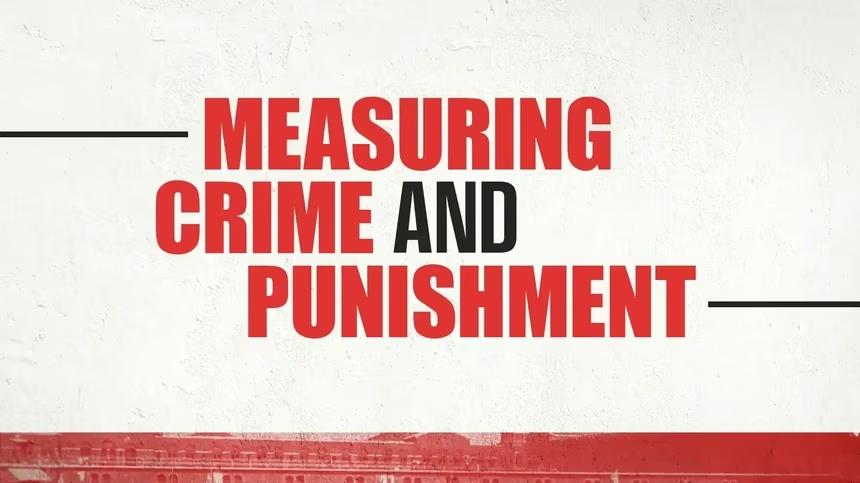
Measuring Crime and Punishment
How does the way we collect and measure crime shape our understanding of it? Crime statistics can tell us how crime changes over time. But the way crime is measured, defined, and communicated can also shape public perception and policy.Providing Support for PBS.org
Learn Moreabout PBS online sponsorship[Radio] Betts: What does it mean to be accountable?
I went to prison at 16.
I was trying to survive prison.
When was I supposed to find time to figure out what it meant to-- to be accountable?
You know, it's like you... you dig a hole in the ground and then you spend the rest of your life trying to fill that hole... [Indistinct chatter] but how do you quantify that and how do you admit that you got to rebuild something that you had a hand in destroying?
The hardest thing to admit is that you did a wrong and you have no solution for fixing it.
[Rumbling] ♪ [Man singing in Indigenous language] Voice: My kinsmen, a great wrong has been done to us.
We have been outraged and caused to weep without shame, men though we are.
So of course it would be right for us to go out and do to the murderer what he has done to our loved one.
Antelope.
Narrator: For thousands of years, long before European settlers arrived in North America, the continent's Native nations administered justice according to their own traditions.
Depending on the severity of the offense, those who broke the rules could be reprimanded by tribal elders, commanded to apologize, to make reparations, to undergo a cleansing ceremony, or they could be banished.
N. Bruce Duthu: If someone did go off the tracks, there were likely reasons, maybe deep in the structure of that family, in the way that that family nurtured this individual, or perhaps didn't, so the question is really, what did we all do that may have contributed to this disruption, this rupture of the peace in our community, and how do we collectively atone for that?
Narrator: To restore the peace, different nations had different approaches.
Among the Dakota people, if one member of the tribe murdered another, a male relative of the victim was expected to kill the murderer.
If no one relative was willing to act, the tribal council decreed that all the men in the family would impose the punishment together.
Voice: It was a solemn day.
Men, women, and children thronged about, for this was something everyone dreaded both to see and to miss seeing.
The relatives of the slain man were required to shoot, thus all inflicting together the punishment that none would undertake alone, and then the murderer was down, with as many arrows sticking into his back as his victim had male relatives.
[White Horse] Narrator: The Dakota had another way of responding to homicide, but it was almost never undertaken.
Instead of seeking vengeance, the victim's family would agree to adopt the man who had wronged them.
Voice: On the appointed day, the leading men of the tribe and the relatives assembled in the council tipi; soon, the speaker was saying, "Smoke now, with these, your new kinsmen, "for they have decided to take you to themselves in place of the One-who-is-not-here."
[White Horse] Bryan Stevenson: What you saw, in many Indigenous communities was this evolving notion that restorative justice can sometimes be healthier for a community than retributive justice, that is, the idea that you do harm to the person who's done harm to you can create a lot of resentment and ongoing-- it doesn't resolve some of the tensions, where restorative justice is very much rooted in the idea that we want resolution.
We want to all move forward toward healing; we want to limit further harm, not just be prepared to punish more harm.
Voice: Killing would only take an instant, and it would be simple, but it would not end the hate.
To win the murderer by kinship and kindness was the surer way.
How proud must their murdered kinsman have been, looking backward from Ghostland and seeing what they were doing!
[Antelope] ♪ Voice: If any person shall commit burglary, such person shall for the first offense be branded on the forehead with the letter B, and if any person shall commit burglary on the Lord's day, he shall have one of his ears cut off, and if he shall fall into the like offense the third time, he shall be put to death.
The Charters and General Laws of the Colony and Province of Massachusetts Bay.
[People shouting, whip cracks] Narrator: When Europeans arrived in America, they brought their forms of justice with them.
Colonists accused of crimes were held in jail until their cases were resolved.
If they were found guilty, they were punished harshly and in public.
Mangual: The idea was to satiate their desire for justice to be done, and if the government fails to meet that moral standard that is widespread throughout society, what happens is that the society will then take the law into their own hands, but also, by doing these things in public, it could help maximize the deterrent impact.
Imagine seeing somebody hang.
That is absolutely going to have an impact in terms of, you know, people committing a criminal offense.
They might then see that and say, "OK, well, I'm--I'll think twice about that."
Narrator: Throughout the colonies, rape, treason, and murder were punishable by death, and so were many other crimes: forgery, adultery, aiding runaway slaves, stealing horses, and witchcraft... [Fire crackling] but by the time of the Revolution, many Americans had come to see brutal public punishments as a symbol of the tyranny they were determined to overthrow.
In declaring their independence from England, America's founders promised to establish a government that would recognize and protect the inalienable rights of man.
Breyer: "We hold these truths to be self-evident, "that all men are created equal, "that they are endowed by their creator with certain "inalienable rights, that among these are life, liberty, and the pursuit of happiness."
There it is.
In a sentence.
In a sentence.
Basic beliefs in this document that underlies, at least in theory, and not always in practice, but at least in theory, how we want this country to be seen and to be run.
Narrator: The new nation, John Adams said, must have a "government of laws, and not of men," where all had the right to be treated fairly and impartially.
♪ Mangual: Our country was founded by virtue of it getting fed up with an oppressive monarchy that had too much power.
It was taxation without representation.
It was people having just soldiers show up at their house and search without any warrants, so everything built into our structure is designed to make sure that the overarching government does not ultimately have, you know, soul-crushing power over the citizenry.
Narrator: After lengthy negotiations, the Constitution of the United States was enacted in 1789.
It was the result of many compromises, including whether slavery would be allowed to continue and the balance between state and federal powers.
Each state retained the authority to write its own criminal laws and establish punishments for breaking them.
The "Bill of Rights," 10 amendments that were added to the Constitution, protected Americans' right to speak and worship freely and the right to keep and bear arms.
Anyone accused of federal crimes would have "due process of law," an impartial jury, and the "assistance of counsel" for their defense.
They could not be subjected to "excessive bail" or fines or "cruel and unusual punishments."
Stevenson: I do think that the greatness of America was our ability to articulate a vision of democracy, a vision of a just society that created for every individual a commitment to fairness and equality and justice, and that remains at the core of what makes America this exciting idea in the minds of so many.
Of course, we very quickly failed to honor those ideas by what we were doing.
Duthu: We know that when the Constitution uses the first 3 words of the Preamble, "We the people," for every "We," there's an excluded "They."
Women were not included, Native Peoples were not included, African Americans were not included, so one has to hold dear to the idea that this was the beginning, it was not the end point.
Rebecca McLennan: I think the revolutionary generation got a lot of things wrong, but they were really energized by the Enlightenment, and they saw themselves as at the forefront of human history.
They were extremely committed to this moral project of doing something that had never been done before, and also, they had a narcissistic self-confidence that basically you could perform a surgery on the souls of men.
 New
America Creates the World’s First Penitentiary
Video has Closed Captions
Clip: Ep1 | 8m 30s | The Founding Father Benjamin Rush offers a new form of punishment: the world's first penitentiary. (8m 30s)
 New
Austin Reed Details His Experiences in Auburn Prison
Video has Closed Captions
Clip: Ep1 | 9m 40s | Austin Reed recounts his experiences over two decades of being incarcerated in Auburn Prison. (9m 40s)
 New
Elam Lynds Reforms the Auburn Prison System
Video has Closed Captions
Clip: Ep1 | 2m 21s | The new head guard at Auburn Prison establishes a new strict regimen of efficiency and order. (2m 21s)
 New
The House of Refuge and Juvenile Detention
Video has Closed Captions
Clip: Ep1 | 3m 58s | The House of Refuge is the nation's first institution for the reformation of juvenile delinquents. (3m 58s)
 New
The Largest Mass Hanging in American History
Video has Closed Captions
Clip: Ep1 | 4m 26s | President Abraham Lincoln sentences 38 Native Americans to death for attacks against settlers. (4m 26s)
 New
Levi Ames and the Spectacle of Public Execution
Video has Closed Captions
Clip: Ep1 | 2m 45s | There has always been a fascination with those that commit crimes and how they're punished for them. (2m 45s)
 New
The Myths and Fascination with the Outlaw Jesse James
Video has Closed Captions
Clip: Ep1 | 13m 42s | During the Reconstruction Era, an outlaw captures the public's attention: Jesse James. (13m 42s)
Providing Support for PBS.org
Learn Moreabout PBS online sponsorship








Support for PBS provided by:
Episodes presented in 4K UHD on supported devices. Major funding for CRIME AND PUNISHMENT IN AMERICA was provided by The Atlantic Philanthropies, Emerson Collective, The Andrew W. Mellon Foundation, and...