
What It Takes to Film Elephants in the Wild
Clip: Season 44 Episode 5 | 5m 41sVideo has Closed Captions
Cinematographer Bob Poole shares how his passion for elephants shapes his approach to filmmaking.
Emmy Award-winning cinematographer Bob Poole shares how his lifelong passion for elephants shapes his approach to wildlife filmmaking. Working in unpredictable environments, he explains what it takes to film respectfully while prioritizing animal comfort and maintaining distance.
Problems playing video? | Closed Captioning Feedback
Problems playing video? | Closed Captioning Feedback
Major support for NATURE is provided by The Arnhold Family in memory of Henry and Clarisse Arnhold, Sue and Edgar Wachenheim III, The Fairweather Foundation, Charles Rosenblum, Kathy Chiao and...
What It Takes to Film Elephants in the Wild
Clip: Season 44 Episode 5 | 5m 41sVideo has Closed Captions
Emmy Award-winning cinematographer Bob Poole shares how his lifelong passion for elephants shapes his approach to wildlife filmmaking. Working in unpredictable environments, he explains what it takes to film respectfully while prioritizing animal comfort and maintaining distance.
Problems playing video? | Closed Captioning Feedback
How to Watch Nature
Nature is available to stream on pbs.org and the free PBS App, available on iPhone, Apple TV, Android TV, Android smartphones, Amazon Fire TV, Amazon Fire Tablet, Roku, Samsung Smart TV, and Vizio.
Buy Now
Explore More Ways to Watch
Bring the beauty and wonders of wildlife and natural history into your home with classic NATURE episodes.Providing Support for PBS.org
Learn Moreabout PBS online sponsorship- I was born in the States, my parents are American.
We moved to Malawi when I was three years old, and then we moved here to Kenya.
I remember there's a great photograph of my sister Joyce and I at this place where we are right now.
My dad, of course, always behind the camera, with this enormous bull standing next to one of these cottages, and Joyce and I just kind of in the foreground with this enormous thing over our shoulders.
Elephants have always been a big part of my life, and I don't feel like their story's really ever told or people that really get it.
All across Africa, there are elephants, but there are very few places that have 50-year-old bulls.
And that's because bulls are the first to get hunted, they're the first to get poached.
They're so important because the big bulls are the ones that do all the breeding and they pass on their genes.
In order to do that, they have to be really successful.
So that is the story that I wanted to tell, a story about my sister's work here in Amboseli.
Joyce at a very early age came out and started studying bull elephants, and she made remarkable discoveries, like musth, the cycle that males go through when they become sexually active.
So Joyce is really the reason why this has all happened.
- When I was 19, I got the opportunity to come to Amboseli and study the elephants here.
And they're just so big, they're so awe inspiring.
They're so different from us, and yet so alike.
Their social structure, their compassion for one another.
They're so caring, family-oriented.
They're just so exciting to spend time with.
- So much goes into this, months and months of preparation to get here.
Obviously I'm not out here in a vacuum, I've got a lot of help.
My wife, Gina, she's amazing.
She is the one who keeps us on budget, organizes the shipping, the logistics, not to mention that she shoots stills, does sound, runs a gimbal.
Impossible to be here without her.
Gina likes to say that she married an elephant family.
- I did.
(laughing) I married an elephant family.
(laughing) The first time I came to Africa was with Bob, and we were heading to this park.
And pretty soon, we were surrounded by this family, and they were just gently grabbing the grass and eating it, and it reminded me of a ballet, like a core of ballet dancers all around us.
And there was something about that moment that it just kind of went to my core, and I thought, "I wanna come back here.
I can't not have this in my life."
Over the years, we've done quite a few films together.
I'm pretty happy I married this elephant family, (laughing) and now we have a new member.
(Thomas and Gina laughing) - Bob is my fiance's uncle.
We met when I came out on Safari with her for the first time, and I'd gone to school to study film.
And yeah, we just kind of hit it off.
I really wanted to learn more about wildlife filmmaking and conservation filmmaking, and that's what I really wanted to do.
And I'd always been interested in wildlife, because growing up, the BBC was always there, every Sunday, and I'd just watched these sequences of elephants, and in the back of my mind, always just, "I wanna to be there.
I wanna be doing what they are doing."
Since he heard that, he could see that I was like dedicated to whatever I put my mind to, and he always wanted to try and like get me involved with him and try and find a project that would really get me on board and collaborate.
- [Bob] Tom's the perfect guy.
We call him Calm Strong Tom.
There's not many people that would've been able to handle it.
This jib is homemade, you know, he's basically zoom, focus, pan, tilt, and swinging a jib all in one.
You know, it's a three-person job almost.
And then middle of the night, everybody's gone to bed and I'm like screening this footage.
I'm just like, "Oh my God, that's a beautifully composed image."
I really don't think I could've done this one without him.
We had a lot of challenges on this shoot.
We had torrential downpour rain, and trying to deal with this kind of relatively open vehicle was a challenge.
We had some equipment failures, which really set us back.
On top of that, elephants are smart and they're cautious.
They first saw us in this contraption here, and they are like, "What is this?"
They didn't trust us.
It took time to win their confidence.
- It's like a anything where you have to get into a rhythm.
When we were getting into our rhythm, there was a rhythm of nature happening out here too.
The elephants became more trusting of us.
And when they trust you, they let you into their world.
- [Tom] Some nights, you just don't want to go back 'cause the light's so perfect.
The elephants, they're your friends basically, you're hanging out with them.
And you just don't wanna leave them because you're just having so much fun filming these beautiful creatures.
- [Bob] We are trying to create the desire for people to want to protect these animals.
I want people to understand how special these bulls are, especially the big old ones.
There are just very, very few of them in Africa.
Amboseli's a place where there's a lot of big bulls because they're well protected here.
And when people do come to Amboseli National Park to see something that they saw on TV, it encourages the communities around that these bulls are worth protecting.
- [Tom] We're just telling a story for them to enjoy, and with this film, we hope that it really puts out the message to protect elephants.

Video has Closed Captions
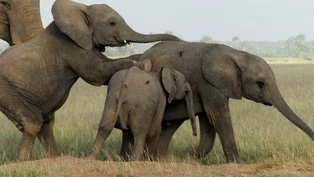
Clip: S44 Ep5 | 2m 13s | Male elephants form powerful bonds — and even become adoptive parents together. (2m 13s)
Video has Closed Captions
Clip: S44 Ep5 | 2m 56s | In Amboseli, one male’s opportunity attracts rivals — and the attention of watching juveniles. (2m 56s)

How Invisible Borders Put Elephants at Risk
Video has Closed Captions
Clip: S44 Ep5 | 2m 27s | Esau’s journey spans borders that elephants cannot see — but must obey. (2m 27s)
Video has Closed Captions
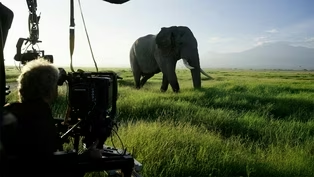
Clip: S44 Ep5 | 8m 27s | Go behind the scenes of "Tusker: Brotherhood of Elephants." (8m 27s)

Preview of Tusker: Brotherhood of Elephants
Video has Closed Captions
Preview: S44 Ep5 | 30s | Follow the complex lives of giant elephant bulls in Amboseli and Mount Kilimanjaro. (30s)
Providing Support for PBS.org
Learn Moreabout PBS online sponsorship
- Science and Nature

Explore scientific discoveries on television's most acclaimed science documentary series.












Support for PBS provided by:
Major support for NATURE is provided by The Arnhold Family in memory of Henry and Clarisse Arnhold, Sue and Edgar Wachenheim III, The Fairweather Foundation, Charles Rosenblum, Kathy Chiao and...